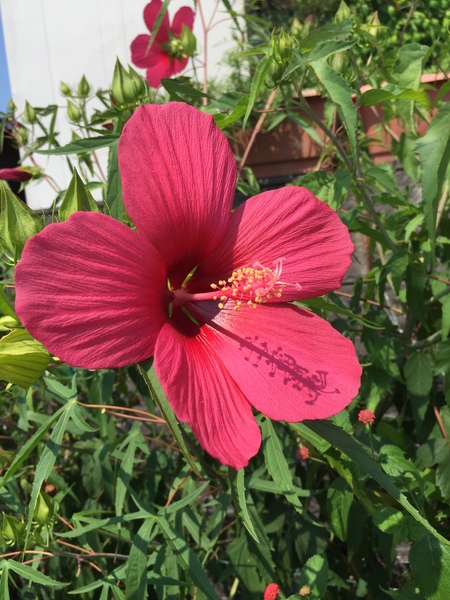
Japanese name: モミジアオイ(紅葉葵) Scientific name:Hibiscus coccineus
[Overview]
A perennial 1–2 m tall.
The leaves are alternate, about 12–15 cm wide, and deeply palmately divided into 3–7 lobes.
The leaf margins are toothed.
The leaf stalks are long.
The flowers are borne singly in the leaf axils at the top of the stem and are red, five-petaled, 12–20 cm across.
The calyx is 2.5–5 cm long with triangular lobes.
There are 10–12 linear bracteoles, 1.5–3 cm long and shorter than the calyx.
The flowers open in the morning and wilt by evening, lasting only one day.
The fruit is an ovoid capsule about 2–2.5 cm long with a short beak-like projection.
The seeds are spherical with short hairs.
[Cultivation]
Propagate from seed or by division.
It prefers sunny, well-drained, moisture-retentive, fertile soil.
In winter, cut the dead stems at ground level and protect the plant from cold with mounded soil or a straw mulch.
For potted plants, take care not to let them run out of water; from spring to autumn, water when the soil surface dries.
Apply compost around the base of the plant in winter, and apply slow-release fertilizer as a top dressing in early summer.
Aphids and leaf rollers can occur.