
Plant Encyclopedia

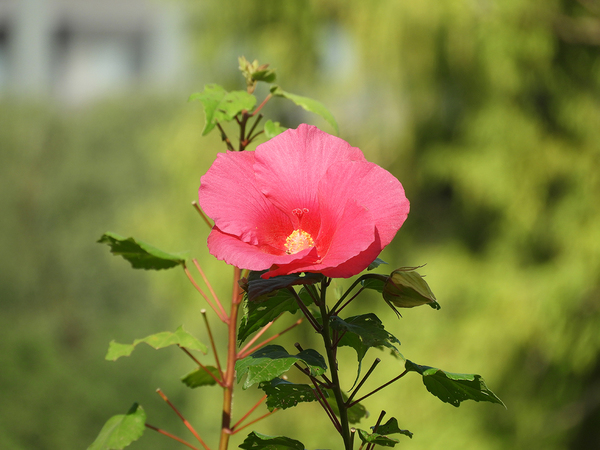
Hibiscus (genus, China rose, "Haibisukasu")
Japanese name: ハイビスカス
Scientific name: Hibiscus
[Overview]
A group of horticultural cultivars of tropical origin.
They are divided mainly into the following three lines.
Hawaiian hibiscus (also called New Type or large-flowered line): Flowers large and rich in color variation. Somewhat delicate.
Old Type (native line): Flowers somewhat small with little variation in color. Flowers freely and is robust.
Coral: Flowers small and borne facing downward. Tall. Strongly heat tolerant and somewhat susceptible to cold. Robust.
There are a great many cultivars, but most are Hawaiian hibiscus.
The flowers open in the morning and wither by evening, lasting only one day.
In the tropics it flowers all year round.
[Cultivation]
Propagate by cuttings or grafting.
Cuttings are taken in April–June for Old Type and Hawaiian hibiscus, and in May–September for Coral.
It prefers fertile soil in a sunny, well-drained site.
The plant tends to weaken in summer heat, so in midsummer move it to a well-ventilated place in partial shade.
Hawaiian hibiscus in particular is susceptible to heat.
In winter keep it indoors in a warm place by a window, but in regions without frost it can also overwinter outdoors.
From spring to autumn, water thoroughly when the soil surface dries.
In particular, during the flowering period the flowers drop if the plant runs short of water.
Apply slow-release fertilizer from spring to autumn, but too much nitrogen produces only leaves and no flowers, so use a fertilizer rich in phosphorus and potassium.
No fertilizer is needed when the plant is weakened by summer heat or in winter when growth stops.
Remove spent flowers promptly.
Pests and diseases include aphids, spider mites, leafrollers and scale insects.
Details
Japanese: ハイビスカス
Translated from our Japanese encyclopedia. If anything differs, the Japanese page is correct.