
Plant Encyclopedia

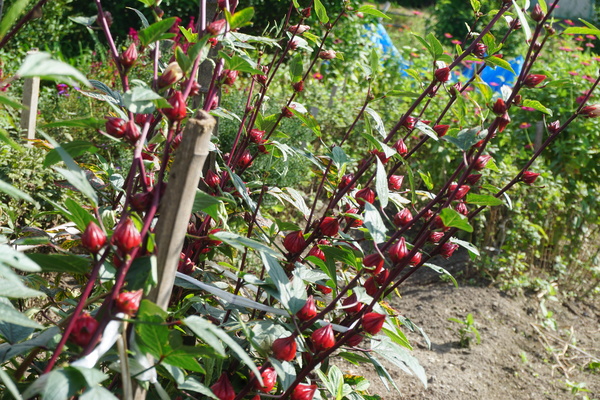
Hibiscus sabdariffa (roselle)
Japanese name: ローゼル
Scientific name: Hibiscus sabdariffa
[Overview]
A woody perennial or shrub 2–2.5 m tall.
It is sensitive to cold, so it is treated as an annual in Japan.
The leaves are alternate, elliptical, about 8–15 cm long, simple, either palmately 3-lobed or undivided, with toothed margins.
There are long petioles.
The flowers are solitary in the leaf axils in the upper part of the stem; they are 5-petaled, 8–10 cm across, and pale yellow or tinged with red.
The center of the flower is dark crimson.
The calyx and bracteoles are red.
The calyx is 1–2 cm long, but as the fruit matures it grows to 3–3.5 cm long and becomes succulent.
The fruit is a capsule enclosed in the enlarged calyx.
[Uses]
The fruit is made into hibiscus tea and used as a raw material for flavorings, colorings, jelly, jam, roselle liquor, and more.
The young leaves, stems, flowers, fruits, and seeds are edible.
Fiber is obtained from the stem.
Oil is obtained from the seeds.
It is also used medicinally.
[Cultivation]
Propagate from seed.
It prefers fertile soil that is sunny, well drained, and moisture-retentive.
Water thoroughly when the soil surface dries.
Apply slow-release fertilizer during the growing season.
Aphids can occur.
Details
Japanese: ローゼル、ローゼルソウ、ローゼリソウ、ロゼリソウ、ベニアオイ
Translated from our Japanese encyclopedia. If anything differs, the Japanese page is correct.