
Plant Encyclopedia

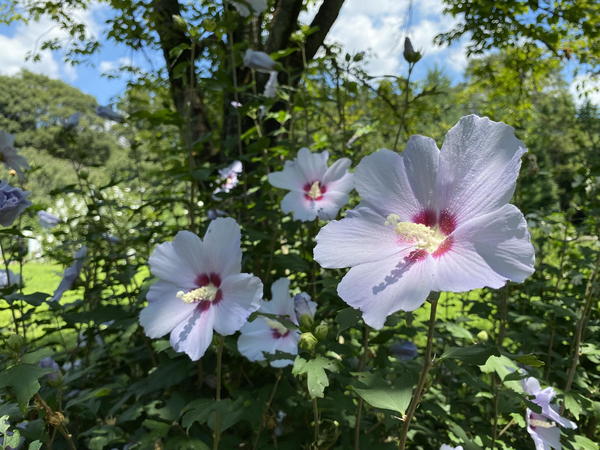
Hibiscus syriacus (rose-of-Sharon, "Mukuge")
Japanese name: ムクゲ (槿)
Scientific name: Hibiscus syriacus
[Overview]
A deciduous shrub 3–4 m tall.
The branches are grayish white, and young branches have stellate hairs.
It branches well, but the branches grow upward, giving an upright habit.
The leaves are simple and alternate, ovate, about 4–10 cm long and 2.5–5 cm wide, usually 3-lobed with 3–5 conspicuous veins.
The leaf margins have coarse teeth, and stellate hairs grow on both surfaces.
The flowers are borne singly in the leaf axils and are 5-petaled, about 10 cm across.
The flower color varies, including reddish purple, white and violet, and many have a darker center (a dark eye).
The flowers open in the morning and wither by evening of the same day, but they bloom one after another.
The flower stalks are densely covered with stellate hairs.
The fruit is an ovoid capsule 1.5–2 cm long and 1.3 cm wide, densely covered with yellowish brown stellate hairs.
[History]
In Japan it has been cultivated since the Edo period, and many cultivars have been developed.
[Uses]
It is the national flower of South Korea.
In China, the bark, seeds and flowers are used medicinally.
[Cultivation]
Propagate from seed or by cuttings.
It prefers a sunny, well-drained site.
It is easy to grow, but care is needed because it suffers frequent insect damage.
Details
Japanese: ムクゲ(槿)、ハチス(蓮)
Translated from our Japanese encyclopedia. If anything differs, the Japanese page is correct.