
Plant Encyclopedia

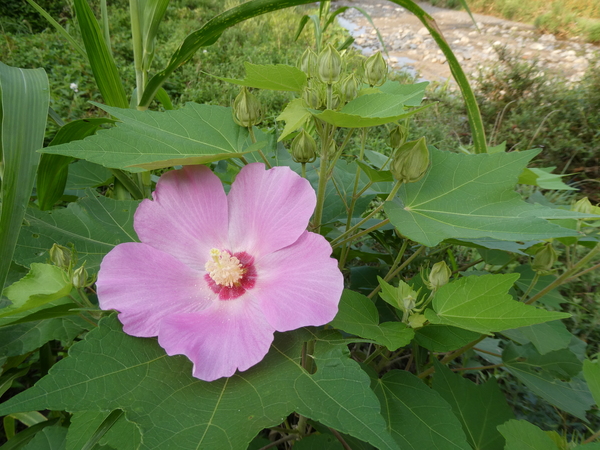
Hibiscus mutabilis (confederate rose, "Fuyo")
Japanese name: フヨウ (芙蓉)
Scientific name: Hibiscus mutabilis
[Overview]
An evergreen shrub 2–5 m tall that loses its leaves in cold regions.
It branches freely and forms a rounded shape.
The leaves are simple and alternate, 10–15 cm long, palmate with 5–7 lobes (usually 3 shallow lobes).
The leaf margin is slightly serrate and densely hairy.
There is a long petiole.
The flowers are borne singly in the leaf axils, 10–13 cm across, white to pink with 5 petals, though some are double-flowered.
The staminal column does not protrude beyond the flower.
The calyx is 20–35 mm long, with lobes longer than the tube, and has nectaries.
The flower stalk is 3–8 cm.
The flowers open in the morning and wither by evening, lasting only one day.
The fruit is a spherical capsule about 2–2.5 cm in diameter containing many seeds.
The seeds are about 2 mm long and have long cottony hairs.
[History]
It is presumed to be native to China, and plants found in Shikoku and farther south in Japan are thought to be naturalized.
There are records that it was cultivated as an ornamental in the Muromachi period.
[Cultivation]
Propagate from seed or by cuttings.
It prefers sunny, well-drained, moisture-retentive soil rich in humus.
It has weak cold tolerance, and overwintering in the open ground is possible south of Kanto. In cold regions it loses its leaves or its branches die back.
Take care that it is not exposed to cold wind or frost in winter.
Water when the soil surface dries.
Apply compost around the base in winter, and top-dress with slow-release fertilizer in early summer and autumn.
Prune in the leafless period in winter.
In regions where it loses its leaves in winter, it is good to cut it back hard to near the base and protect it from the cold with mulch or similar.
Pests and diseases include aphids, spider mites, leaf rollers, longhorn beetles and scale insects.
Details
Japanese: フヨウ(芙蓉)、モクフヨウ(木芙蓉)
Translated from our Japanese encyclopedia. If anything differs, the Japanese page is correct.