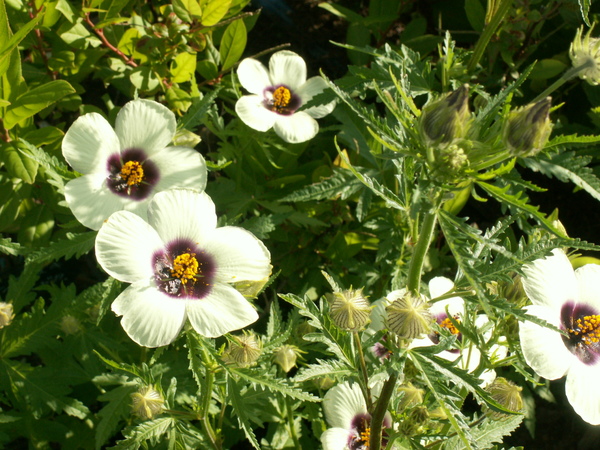
Japanese name: ギンセンカ(銀銭花) Scientific name:Hibiscus trionum
[Overview]
An annual 30–60 cm tall, though in warm regions it may become a short-lived perennial.
Young stems and leaves are hairy.
The leaves are alternate, about 7 cm long, palmately divided into 3–5 lobes, and the lobes are further pinnately divided.
The flowers are borne singly in the leaf axils and are cream-colored, 5-petaled, 3 cm across.
The center of the flower is dark purple.
The calyx is membranous and 5-lobed; the lobes are broadly ovate with black ridges and have spreading hairs.
At the base of the flower are bracts divided completely into about 10 segments.
The flowers stay open for only a few hours in the morning.
The fruit is a capsule enclosed in the greatly inflated calyx.
[History]
It was already recorded by the middle of the Edo period, and is seen sporadically in various places.
[Cultivation]
Propagate from seed.
It prefers a sunny, well-drained, moisture-retentive, fertile site.
For potted plants, water thoroughly when the soil surface dries; for plants in the ground, rainfall is sufficient.
If fertilizer is applied at planting, no further fertilizing is particularly necessary.
There are no particular pests or diseases.