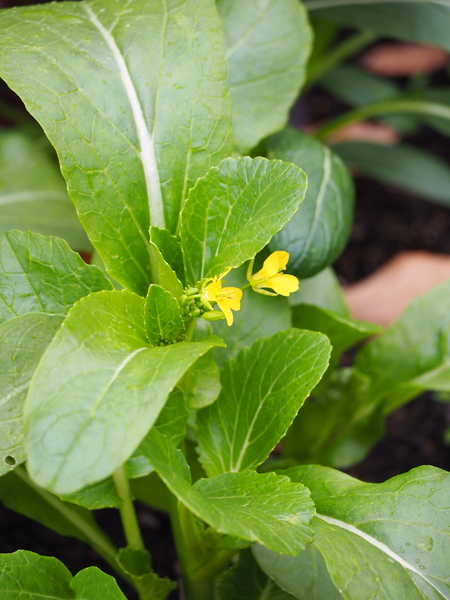
Brassica rapa var. chinensis(bok choy, "Chingensai")
Japanese name: チンゲンサイ(青梗菜) Scientific name:Brassica rapa var. chinensis
[Overview]
A biennial.
The leaf stalks are thick and fleshy and pale green.
The leaves are green, spoon-shaped and entire.
The flowers are borne in racemes at the stem tips and are yellow with 4 petals.
[History]
It is said to have originated in central and southern China, and was introduced to Japan after the normalization of Japan–China relations in 1972.
[Uses]
The leaves and stems are used as a vegetable.
It has little bitterness and does not fall apart when cooked, so it is used in stir-fries, soups and the like.
[Cultivation]
Pests include aphids, cabbage worms and cutworms.
[Notes]
It is written "青梗菜"; 梗 refers to the shaft or stem, and it is written this way because this part is green.