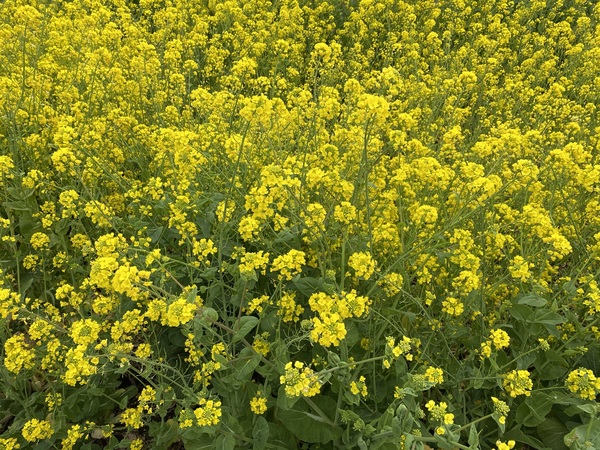
Japanese name: セイヨウアブラナ(西洋油菜) Scientific name:Brassica napus
[Overview]
An annual or biennial 0.3–1 m tall.
It is hairless throughout and covered with wax, giving it a powdery white tinge.
The leaves consist of basal leaves and leaves arranged alternately on the stem; the basal leaves and the leaves on the lower stem are pinnately lobed, with a large terminal lobe, and have petioles.
The leaves on the upper stem are simple, oblong to lanceolate, sessile, and clasp the stem with ear-shaped bases.
The leaves are thick.
The flowers are borne in racemes at the stem tips and are yellow with 4 petals.
The sepals do not spread open at flowering.
The fruit is a siliqua 5–10 cm long, held ascending, with a fruit stalk 1–3 cm long.
[History]
It was introduced to Japan in the early Meiji period to obtain rapeseed oil.
[Uses]
Rapeseed oil is obtained from the seeds.
[Cultivation]
Pests and diseases include virus disease, clubroot, downy mildew, aphids, diamondback moths and armyworms.