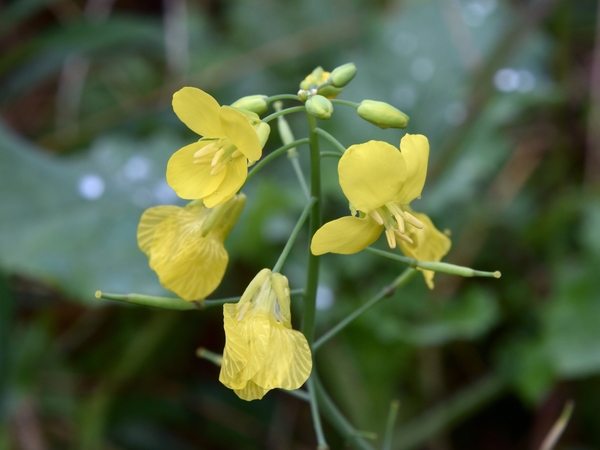
Japanese name: カラシナ(芥子菜) Scientific name:Brassica juncea
[Overview]
A biennial 1–1.5 m tall.
It is said to originate from Central Asia to the Himalayan region, and is used for oil extraction as well as a vegetable.
The type commonly seen in Japan is the vegetable cultivar.
The stems and leaves are hairy.
The leaves are alternate, and the lower leaves are irregularly pinnately lobed.
The flowers are borne in racemes at the stem tips and are yellow with 4 petals.
The leaves and seeds contain pungent components.
It is broadly divided into 5 groups: the leaf karashina group, the takana group, the fleshy takana group, the stem karashina group and the root karashina group.
[History]
It has been cultivated in China for more than 2,000 years, and also came to Japan long ago.
[Uses]
The leaves are used as a vegetable, mainly pickled.
[Cultivation]
Pests and diseases include virus disease, clubroot, downy mildew, aphids, diamondback moths and armyworms.