
Plant Encyclopedia

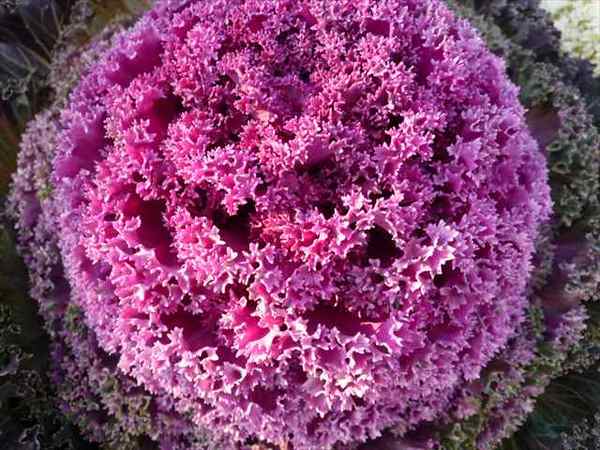
Brassica oleracea var. acephala f. tricolor ("Habotan")
Japanese name: ハボタン (葉牡丹)
Scientific name: Brassica oleracea var. acephala f. tricolor
[Overview]
A cold-hardy biennial, but treated horticulturally as an annual.
The leaves form a rosette and turn red to white as temperatures begin to fall.
There are several strains depending on leaf shape.
Tokyo-maruba group (Edo-habotan): the oldest strain, continuing from the Edo period.
The leaves are round like cabbage, and the plant is hardy, tolerating both cold and heat.
Nagoya-chirimen group: a strain developed in the Nagoya region in the mid-Meiji period by crossing with curly-leaved kale.
Osaka-maruba group: created in Osaka after the war, with leaves intermediate in form between the Nagoya-chirimen group, which has wavy leaf margins, and the Tokyo-maruba group.
Many of them color early and vividly.
Kireba group: a strain with finely cut leaves.
There are various other Habotan besides these representative strains.
The flowers are borne in racemes at the stem tips and are pale yellow with 4 petals.
[History]
It is thought to have been improved from kale, a relative of cabbage, and is said to have arrived in Japan in 1778.
[Uses]
The colored leaves are enjoyed for ornament.
[Cultivation]
It prefers organically rich soil that is sunny, well drained and moisture-retentive.
To enjoy it in good condition for a long time, protect it from cold winter winds and heavy frost.
For potted plants, water thoroughly when the soil surface dries.
For plants in the garden, watering is not particularly necessary.
Apply slow-release fertilizer from May to September, and avoid over-fertilizing once temperatures begin to fall and the leaves start to color.
In hot, humid conditions, excess fertilizer makes black rot more likely, but a lack of fertilizer makes the leaf color poor.
Fertilizer high in nitrogen also makes the color poor.
Because of problems with continuous cropping, take care not to grow it in the same place for several years.
Pests and diseases include black rot, aphids, diamondback moths, cutworms and cabbage worms.
Details
Translated from our Japanese encyclopedia. If anything differs, the Japanese page is correct.