
Plant Encyclopedia

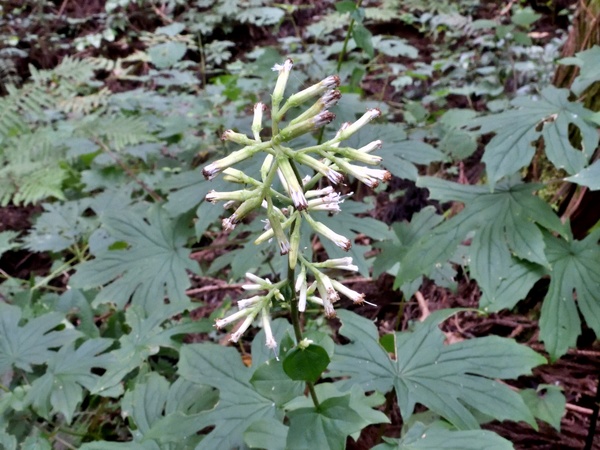
Parasenecio delphiniifolius var. delphiniifolius ("Momijigasa")
Japanese name: モミジガサ (紅葉傘、紅葉笠)
Scientific name: Parasenecio delphiniifolius var. delphiniifolius
[Overview]
A perennial 40–120 cm tall, found in broadleaf forests.
It has a short rhizome.
The stem is erect and unbranched.
There are basal leaves and stem leaves; the basal leaves have withered by the flowering season.
The stem leaves are alternate, up to 20 cm long and 25 cm wide, and palmately divided into 7 lobes.
On the underside of the leaf the veins are not raised, and there are appressed hairs.
The petiole is 14 cm long and has no wings; its base clasps the stem and has small auricles.
The leaf sheath does not close into a cylinder.
White flower heads, sometimes slightly tinged with purple, are borne in a panicle.
The fruit is an achene with a white pappus.
[Uses]
The young shoots are used as a wild vegetable.
[Cultivation]
Propagate from seed, by division, or by shoot cuttings.
It prefers partial shade and moderately moist soil that is well drained and retains water well.
When planting in the ground, it is best planted under deciduous trees.
For potted plants, water thoroughly when the soil surface dries; for plants in the ground, rainfall is sufficient unless summer brings a long spell of sunny weather and the soil dries out.
If a basal fertilizer is applied, no further fertilizing is particularly necessary.
Pests and diseases include powdery mildew and leaf miner flies.
Details
Translated from our Japanese encyclopedia. If anything differs, the Japanese page is correct.