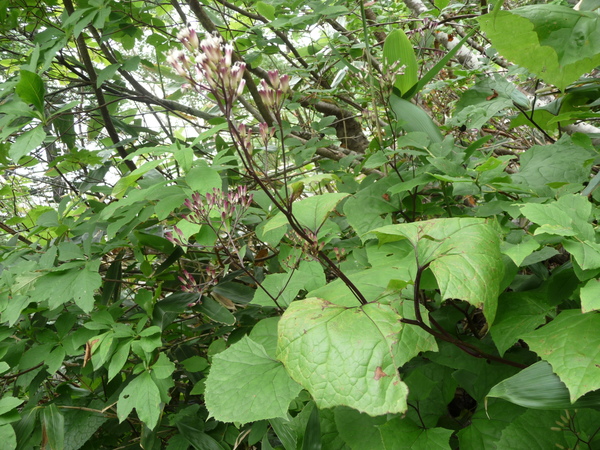
Japanese name: オオカニコウモリ(大蟹蝙蝠) Scientific name:Parasenecio nikomontanus
[Overview]
A perennial 30–100 cm tall, found in broadleaf forests on the Sea of Japan side.
It has a short rhizome.
The stem is tinged with purple and bends in a zigzag.
There are basal leaves and stem leaves; the basal leaves have withered by the flowering season.
The stem leaves are simple and alternate, pentagonal, 5–18 cm long and 10–27 cm wide.
There are brown hairs on the veins of the underside of the leaf.
The petiole is 4–10 cm long and has brown hairs.
The petiole has no wings; its base half clasps the stem and has small auricles.
The leaf sheath does not close into a cylinder.
White flower heads are borne in a corymb.
The fruit is an achene with a white pappus.