
Plant Encyclopedia

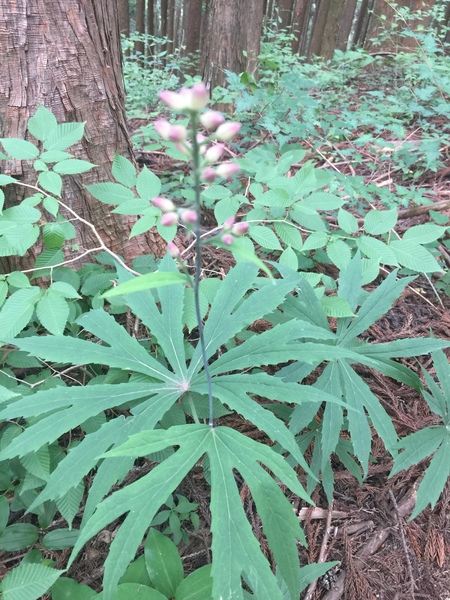
Syneilesis palmata ("Yaburegasa")
Japanese name: ヤブレガサ (破傘、破笠)
Scientific name: Syneilesis palmata
[Overview]
A perennial 70–120 cm tall, found in woodland.
The stem is erect and at first has silky hairs, but later becomes hairless.
Young plants produce only a single basal leaf, and send up a flowering stem when mature.
There are basal leaves and stem leaves; the basal leaves remain even at flowering time.
When the leaves sprout, they are densely covered with cobwebby hairs and appear in a form like a closed umbrella; after unfolding they become hairless.
Two to three stem leaves are borne alternately.
The leaves on the lower part of the stem are round, 35–40 cm across, palmately divided into 7–9 lobes, and each lobe is often further divided in two.
The leaf margins have uneven teeth.
The leaf stalk is attached peltately, 7–15 cm long, and its base forms a sheath that clasps the stem.
In plants from Kyushu, bulbils form in the axils of the stem leaves.
Flower heads 0.8–1 cm across are borne in panicles at the stem tip.
The flower heads consist only of 7–13 tubular florets and are white to pale pink.
The fruit is an achene with a pappus.
[Uses]
The rhizome is used medicinally, and the new shoots are used as a wild vegetable.
[Cultivation]
Propagate from seed, by division, or by root cuttings.
Finish repotting before the buds start to grow.
It prefers partial shade and well-drained soil.
For plants in the ground, plant under deciduous trees.
Avoid places with strong wind.
For potted plants, water thoroughly when the soil surface dries; for plants in the ground, rainfall is sufficient unless sunny weather continues in summer and the soil becomes severely dry.
Apply a fertilizer rich in phosphorus and potassium at planting, and also give liquid fertilizer diluted 2000 times once every 2 weeks from spring to autumn.
Use a liquid fertilizer high in nitrogen until before the rainy season and one high in phosphorus and potassium after the rainy season begins, and dilute it more than 2000 times in midsummer.
Pests and diseases include powdery mildew and leafminers.
[Notes]
The Japanese name likens the shape of the young shoots to a "torn umbrella" (yabure-gasa).
Details
Translated from our Japanese encyclopedia. If anything differs, the Japanese page is correct.