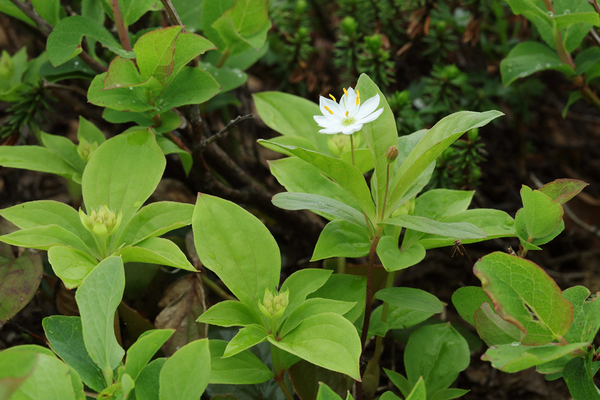
Japanese name: ツマトリソウ(褄取草) Scientific name:Lysimachia europaea
[Overview]
A perennial 10–20 cm tall, found at forest edges and in grassland in the subalpine zone.
The leaves are simple and opposite, somewhat whorled on the upper part of the stem, broadly lanceolate, 2–7 cm long and 1–2.5 cm wide, with a pointed tip.
The flowers are usually solitary in the leaf axils on the upper part of the stem, white, 1–1.5 cm across.
The corolla is 7-lobed; the lobes are oblong with pointed tips, and the tips are sometimes tinged with pale red.
The fruit is a spherical capsule.
[Cultivation]
Propagate from seed or by division.
It prefers partial shade and well-drained soil.
In summer, move it to cool, airy shade.
Water thoroughly when the soil surface dries.
Apply base fertilizer, and in spring either place slow-release fertilizer on the soil or give diluted liquid fertilizer.
There are no particular pests or diseases.
[Notes]
The name is said to derive from the fact that the edge of the corolla is sometimes edged in red.