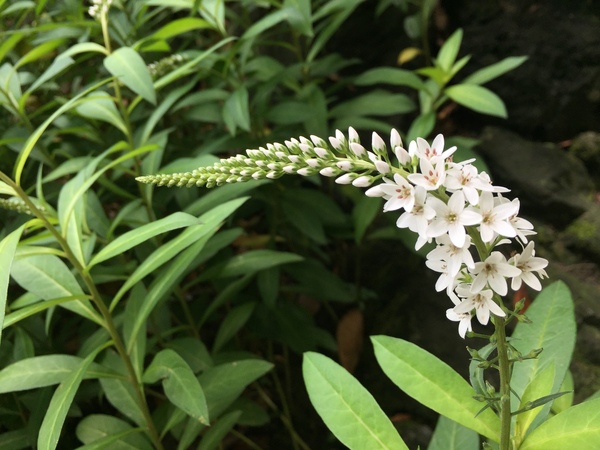
Japanese name: オカトラノオ(岡虎尾) Scientific name:Lysimachia clethroides
[Overview]
A perennial 60–100 cm tall, found in sunny grasslands in hilly areas.
It has long creeping underground stems.
The stem is cylindrical and erect, with sparse short white hairs.
The leaves are simple and alternate, lanceolate to oblong, 6–13 cm long and 2–5 cm wide.
Short hairs grow sparsely on the upper surface of the leaf and on the veins of the underside.
The leaves have sparse glandular dots.
A raceme 10–30 cm long and 2–3 cm across, with the upper part drooping, arises at the stem tip and bears many flowers all on one side.
The flowers are white, 8–12 mm across; the corolla is 5-lobed.
The flower stalk is 6–10 mm long.
The fruit is a spherical capsule 2.5 mm across.
[Cultivation]
Propagate from seed or by division.
As long as the site is sunny and well drained, it is not particular about soil.
In poor sunlight, flowering is poor.
If the conditions suit it, it grows well even when left alone.
For potted plants, water thoroughly when the soil surface dries; for plants in the ground, rainfall is sufficient.
Fertilizer is hardly necessary, but for potted plants a small amount of slow-release fertilizer may be given in spring.
Pests include aphids and cutworms.