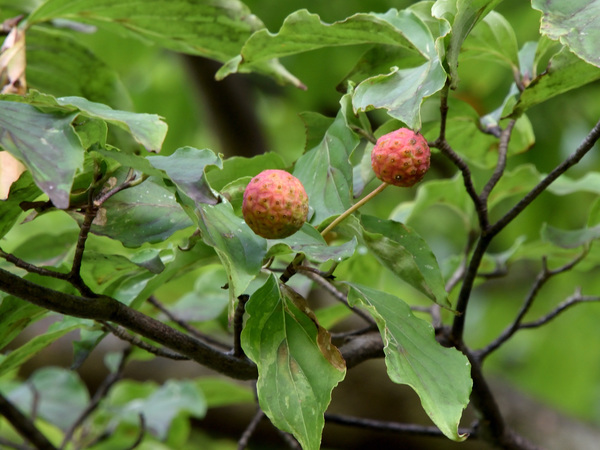
Japanese name: ヤマボウシ(山法師) Scientific name:Cornus kousa subsp. kousa
[Overview]
A deciduous tree commonly found in mountains on the Pacific side.
It grows to about 10 m tall and puts out branches horizontally.
The trunk is grayish brown.
Leaves are opposite, elliptic to ovate, 6–12 cm long and 3.5–6 cm wide, with entire margins.
The leaf margin is wavy.
There are 4–5 pairs of lateral veins.
In autumn the leaves turn dark red.
The flowers are small, greenish-yellow, 4-petaled, and borne in head-like inflorescences at the branch tips.
At the base of the inflorescence are 4 large petal-like involucral bracts.
The bracts are usually 3–6 cm long, ovate to oblong-ovate with sharply pointed tips, pale green at first but gradually turning white, and rarely tinged with red.
It can be distinguished from Hanamizuki (flowering dogwood) by the notched tips of the latter's bracts and by the fact that it flowers before the leaves emerge.
The fruit is a spherical aggregate fruit about 1.2–2 cm across, ripening red.
The yellowish-white flesh is sweet and edible.
[Uses]
The wood is used for utensils.
[Cultivation]
Propagate from seed or by grafting.
It prefers a sunny site with good drainage and good moisture retention.
There are no particular pests or diseases.
[Notes]
The Japanese name "Yamaboshi" is said to have been given because the spherical flower head was likened to a monk's head and the white involucral bracts to a hood.