
Plant Encyclopedia

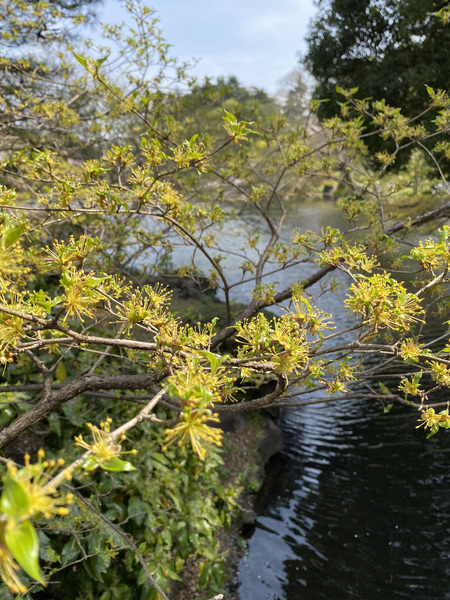
Cornus officinalis (Japanese cornel, "Sanshuyu")
Japanese name: サンシュユ (山茱萸)
Scientific name: Cornus officinalis
[Overview]
A deciduous small tree about 3–7 m tall.
It branches well and grows densely, forming an elliptical crown.
The bark peels off in thin pieces.
Young branches are whitish green.
The leaves are simple and opposite, ovate to oblong-elliptic, 4–10 cm long and 2–6 cm wide.
The leaf margins are entire.
Young leaves have soft white hairs on the underside, but later become hairless except on the veins.
The petiole is 0.6–1 cm long.
Before the leaves emerge, inflorescences enclosed by 4 involucral bracts appear at the branch tips, densely bearing 30–40 flowers.
The flowers are 4–5 mm across, bright yellow, with 4 petals.
The fruit is an elliptical drupe that ripens red.
[History]
It was introduced to Japan in the middle of the Edo period as a medicinal plant.
[Uses]
The fruit, dried after removing the seed, is used medicinally.
[Cultivation]
Propagate from seed or by cuttings.
The best time for cuttings is mid-July.
Avoid transplanting or pruning in early spring, as it weakens the tree.
It prefers fertile soil that is sunny, well drained and moisture-retentive, but is not very particular about soil.
It also tolerates partial shade.
For potted plants, water thoroughly when the soil surface dries.
Apply organic fertilizer around the base of the plant as fertilizer in winter.
Pests and diseases include powdery mildew and saddleback caterpillars.
Details
Japanese: サンシュユ(山茱萸)、ハルコガネバナ(春黄金花)、アキサンゴ(秋珊瑚)
Translated from our Japanese encyclopedia. If anything differs, the Japanese page is correct.