
Plant Encyclopedia

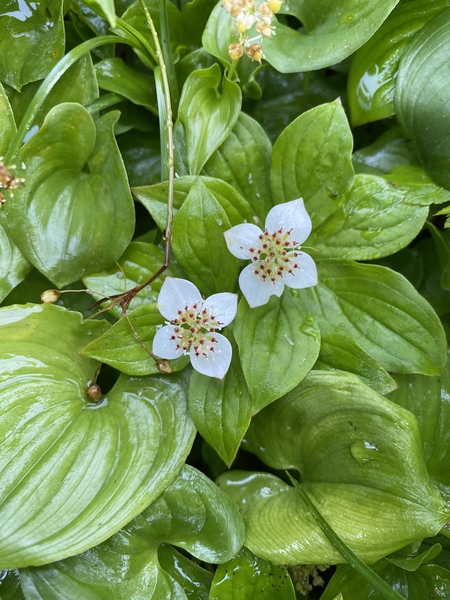
Cornus canadensis ("Gozentachibana")
Japanese name: ゴゼンタチバナ
Scientific name: Cornus canadensis
[Overview]
An evergreen perennial 5–20 cm tall, found in coniferous forests of the subalpine zone.
It has a horizontally extending rhizome.
The stem is erect.
Six leaves are borne in a whorl-like arrangement at the stem tip, but stems that do not bear flowers have four.
In addition, a pair of small leaves grows in the middle of the stem, and there are scale-like leaves at the base.
The leaves at the stem tip are simple, elliptical to broadly ovate, 2–8 cm long and 1–2.5 cm wide, with 2–3 pairs of pinnate lateral veins.
The leaf margins are entire.
The flowers are small, greenish-white, and 4-petaled, borne 10–35 in a head-like inflorescence at the stem tip.
At the base of the inflorescence there are four white, petal-like involucral bracts about 0.7–2.5 cm long.
The fruit is a spherical drupe that ripens red.
[Cultivation]
Propagate from seed or by division; seed should be sown immediately after harvest.
From autumn to spring, keep it in a sunny place, and in midsummer in bright shade in a cool, well-ventilated place.
It prefers well-drained soil.
From autumn to spring, water thoroughly when the soil surface dries; in summer, keep it slightly on the dry side to prevent stuffiness.
In spring, apply slow-release fertilizer placed on the soil.
There are no particular pests or diseases.
Details
Translated from our Japanese encyclopedia. If anything differs, the Japanese page is correct.