
Plant Encyclopedia

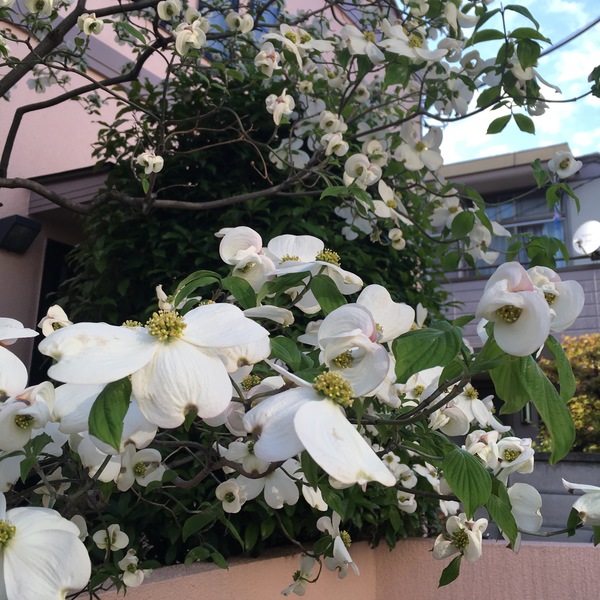
Cornus florida (flowering dogwood, "Hanamizuki")
Japanese name: ハナミズキ (花水木)
Scientific name: Cornus florida
[Overview]
An upright deciduous small tree 4–10 m tall, with a diameter at breast height of 25–40 cm.
The branches are borne in tiers, giving a compact, nearly spherical crown.
The bark is grooved lengthwise and gray-black.
Young branches are green and hairy, but later turn purplish brown and lose their hairs.
The leaves are opposite, simple, elliptic to ovate, 8–10 cm long and 3–5 cm wide.
The underside of the leaf is tinged powdery white and has soft hairs when young.
There are 6–7 pairs of lateral veins.
The leaves turn red in autumn.
The flowers bloom in April–May before the leaves emerge; they are small, greenish-yellow, 4-petaled, and borne in head-like inflorescences at the branch tips.
At the base of the inflorescence there are four large, white, petal-like bracts about 3 cm long.
The tips of the bracts are notched.
The fruit is a compound fruit, ovate to elliptic, ripening red and remaining on the tree after the leaves fall.
[Cultivation]
Propagate from seed or by grafting.
Avoid transplanting or pruning in early spring, as this weakens the tree.
It prefers fertile, moderately moist ground and dislikes strong sunlight striking the trunk.
In dry or poor soil the leaves shrivel and the tree becomes prone to pests and diseases.
It dislikes pruning, which spoils its form, so it is best to secure enough space that cutting back the branches is unnecessary.
The roots are coarse and slow to form new roots, so transplanting a mature tree is difficult, and root pruning in advance is necessary when transplanting.
It is suited to regions from central Tohoku southward.
Pests and diseases include powdery mildew and nettle caterpillars (Iraga).
Details
Japanese: ハナミズキ(花水木)、アメリカヤマボウシ
Translated from our Japanese encyclopedia. If anything differs, the Japanese page is correct.