
Plant Encyclopedia

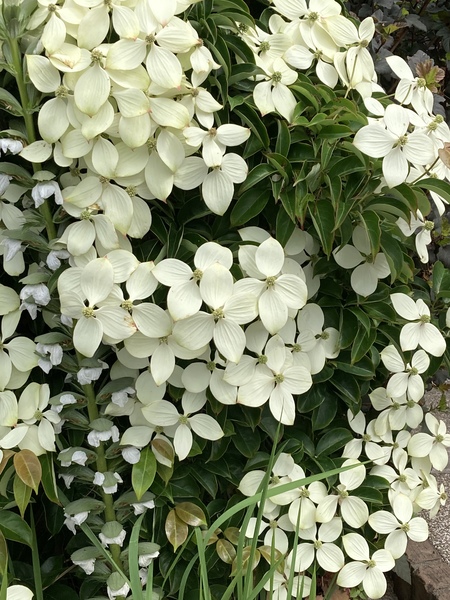
Cornus hongkongensis (Hong Kong dogwood, "Tokiwayamaboshi")
Japanese name: トキワヤマボウシ (常盤山法師)
Scientific name: Cornus hongkongensis
[Overview]
An evergreen shrub to tree about 3–15 m tall.
The leaves are simple and opposite, elliptic, 6.2–13 cm long and 2.5–6.3 cm wide, with entire margins.
The leaves are thick; young leaves are densely covered with short white or brown soft hairs on both sides, but on mature leaves only sparse brown hairs remain on the underside.
The flowers are small, greenish yellow and 4-petaled, borne 40–70 to a head-like inflorescence 0.7–1.3 cm across at the branch tips.
At the base of the inflorescence are 4 elliptic, petal-like involucral bracts, 1.6–4 cm long and 1.3–2 cm wide.
The bracts are yellowish green at first and later turn white.
The fruit is a spherical compound fruit 1.5–2.5 cm across, ripening red to reddish orange.
[Cultivation]
Propagate from seed or by grafting.
Avoid transplanting or pruning in early spring, as it weakens the tree.
It prefers sunny, well-drained, moisture-retentive, fertile, moderately moist sites, and dislikes strong sunlight striking the trunk.
In dry or poor soil the leaves shrivel and the tree becomes susceptible to pests and diseases.
It dislikes pruning, which spoils its shape, so it is best to secure enough space that cutting back the branches is not necessary.
The roots are coarse and root poorly, so transplanting a mature tree is difficult, and root pruning in advance is necessary if it is to be transplanted.
For potted plants, water thoroughly when the soil surface dries; for plants in the ground, rainfall is sufficient.
Apply organic fertilizer around the base of the plant as fertilizer in winter.
Powdery mildew can occur.
Details
Japanese: トキワヤマボウシ(常盤山法師)、ホンコンヤマボウシ(香港山法師)、常緑ヤマボウシ(常緑山法師)
Translated from our Japanese encyclopedia. If anything differs, the Japanese page is correct.