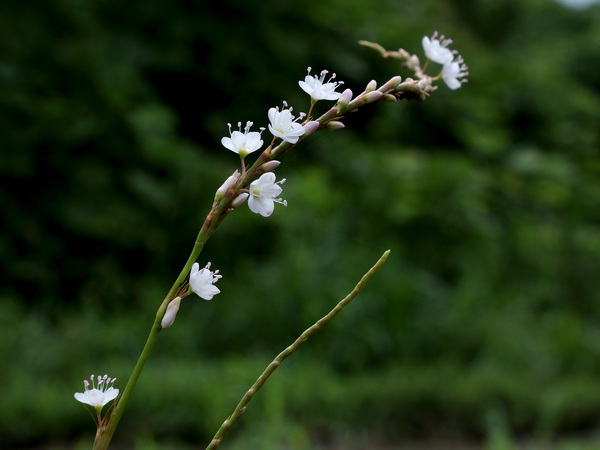
Japanese name: シロバナサクラタデ(白花桜蓼) Scientific name:Persicaria japonica
[Overview]
A perennial 40–100 cm tall, growing in wetlands.
It has a rhizome.
The stem is erect and branches freely.
Leaves are simple and alternate, lanceolate, 7–16 cm long and 1–2.4 cm wide.
Very short appressed hairs grow on the veins and margins of the leaves.
Pseudoracemes at the stem tips bear flowers sparsely.
The inflorescences produced in late autumn are thick and short, and bear flowers densely.
The flowers have no corolla; the conspicuous calyx is white or tinged with red in the upper half.
The fruit is an achene, glossy black.
[Cultivation]
Propagate by division.
It also multiplies readily from self-sown seed.
It prefers sunny soil with good water retention.
If strong midsummer sun scorches the leaves, provide 50–60% shade.
Keep it on the moist side when watering; for potted plants, a saucer may be placed under the pot to keep the base standing in water.
Basal fertilizer alone is sufficient.
There are no particular pests or diseases.