Japanese name: ヤナギタデ(柳蓼) Scientific name:Persicaria hydropiper
[Overview]
An annual 30–80 cm tall, growing at the waterside and on the banks between rice paddies.
There are glandular dots on the underside of the leaves, on the ocrea and on the calyx.
The stem is erect, branched and hairless.
The leaves are simple and alternate, lanceolate to ovate, 3–15 cm long and 0.5–3.5 cm wide.
The leaves are hairless, or hairy only on the veins of the underside and along the margin.
The ocrea is tubular, sparsely hairy, and has short marginal hairs.
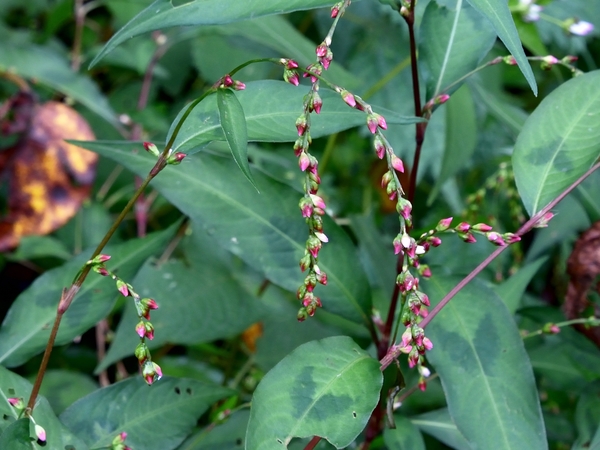
Pseudoracemes 3–11 cm long emerge from the stem tips and leaf axils and bear sparse flowers.
The tip of the inflorescence droops.
The flowers have no corolla; the calyx is green with a tip tinged white to red.
The fruit is an achene, lens-shaped or three-angled, dull dark brown, with fine dot-like projections on the surface.
[Uses]
The leaves are pungent and are used as a garnish for sashimi and in tade-zu (a knotweed vinegar sauce).
The whole plant is used medicinally.
[Notes]
The Japanese name compares the shape of the leaf to a willow leaf.