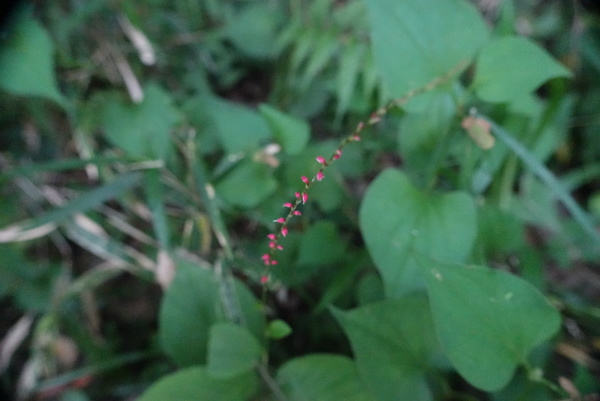
Japanese name: ミズヒキ(水引) Scientific name:Persicaria filiformis
[Overview]
A perennial 30–80 cm tall, commonly seen at woodland edges, in forests and along roadsides.
It has a rhizome.
The stem is erect, sparsely branched and hairy.
The nodes of the stem are swollen.
The leaves are simple and alternate, elliptic, 5–15 cm long and 4–9 cm wide, hairy on both sides, and entire.
The center of the leaf sometimes has a purple inverted-V mark.
Cord-like racemes 20–40 cm long emerge from the stem tips and leaf axils and bear sparse flowers.
There is no corolla; the conspicuous calyx is red in the upper half and white in the lower half.
The fruit is an achene, and because the style remains with a hooked tip, it is carried off by animals or clothing.
[Cultivation]
Propagate by division.
It also multiplies readily from self-sown seed.
It prefers sun to partial shade and a well-drained, moisture-retentive site, and is not particular about soil.
It tolerates shade and damp places and grows well even if left alone.
For potted plants, water thoroughly when the soil surface dries; for plants in the ground, rainfall is sufficient.
Slow-release fertilizer applied as a base fertilizer is enough.
There are no particular pests or diseases.
[Notes]
The Japanese name compares the flower spike to the mizuhiki (decorative cord) tied on gifts.