EVERGREEN

Plant Encyclopedia

Persicaria capitata

Persicaria capitata (pink-headed persicaria, "Himetsurusoba")

Japanese name: ヒメツルソバ (姫蔓蕎麦)
Scientific name: Persicaria capitata

Persicaria capitata

[Overview]
A perennial.
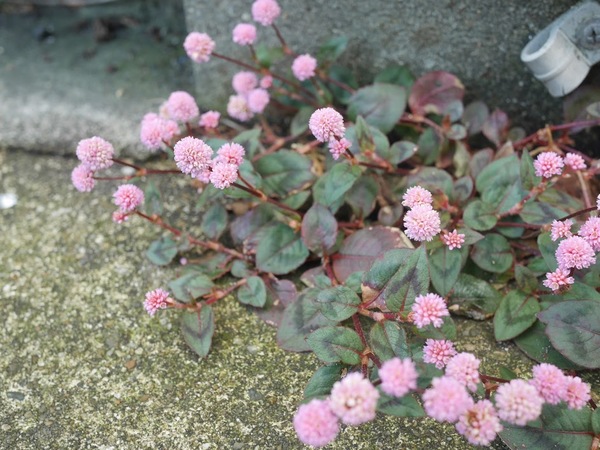
The stems and leaves have reddish-brown hairs.
The stems branch well from the base and spread in a mat, forming a clump about 50 cm across.
Roots form from the nodes that touch the ground.
Leaves are simple and alternate, ovate, with entire margins.
There is a brown V-shaped mark in the center of the leaf.
The leaves turn red in autumn.
Racemes shaped like konpeito (sugar confection) are produced at the stem tips.
There is no corolla; the calyx, which turns a pale reddish purple, is conspicuous.
The fruit is an achene.

[History]
It was introduced to Japan in the Meiji period for use in rock gardens and has become naturalized in various places.

[Cultivation]
Propagate by shoot cuttings.
It also spreads readily from self-sown seed.
If the site is sunny and well drained, it is not particular about soil.
It grows well even when left alone.
For potted plants, water thoroughly when the soil surface dries; for plants in the ground, rainfall is sufficient.
Applying slow-release fertilizer as a base fertilizer is enough.
There are no particular pests or diseases.

Details

Names
English: pink-headed persicaria, pinkhead smartweed, pink knotweed, Japanese knotweed, pink bubble persicaria
Japanese: ヒメツルソバ(姫蔓蕎麦)、カンイタドリ(寒虎杖)
Life form
Perennial
Habit
Terrestrial
Planting (or sowing) season
March, April, May
Flowering season
April, May, June, July, August, September, October, November
Foliage season
January, February, March, April, May, June, July, August, September, October, November, December
Distribution or origin
Himalayas to northern Southeast Asia
Growth form
Creeping
Leaf shape
Simple leaf (unlobed)
Leaf arrangement
Alternate
Leaf margin
Entire
Inflorescence
Raceme
Flower color
Pink
Leaf color
Red, Green, Purple
Availability of seeds and plants
Low
Form sold
Seedlings
Propagation
Bud cuttings
Sun exposure
Full sun
Water needs
Moderate
Soil needs
Required
Tolerance
Heat tolerance
Suitable uses
Ground cover, Potted plant, Flower bed, Parks and gardens, Rooftop greening, Wall greening, Container, Balcony, Hanging basket
Japan Flower Trade Code
50902

Translated from our Japanese encyclopedia. If anything differs, the Japanese page is correct.

Sponsored