
Plant Encyclopedia

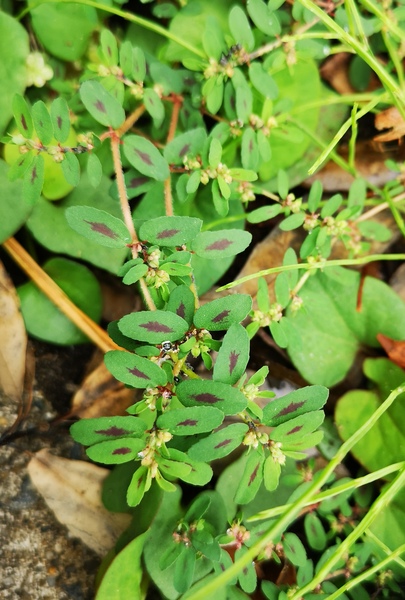
Euphorbia maculata ("Konishikiso")
Japanese name: コニシキソウ (小錦草)
Scientific name: Euphorbia maculata
[Overview]
An annual found along roadsides and in fields.
When the stem or leaves are damaged, a milky-white latex comes out.
The stems creep along the ground, branch freely, and have upward-pointing soft hairs.
The leaves are simple and opposite, elliptical, 0.5–1.5 cm long and 0.2–0.6 cm wide, and often have a dark blotch in the center.
The leaf margins have fine serrations.
The leaf base is asymmetrical.
The upper surface of the leaf is hairless or has long soft hairs, and the underside has soft hairs.
The leaves have triangular stipules.
The petiole is short, hairless or with soft hairs.
Cup-shaped inflorescences (cyathia) are produced at the stem nodes.
The flowers are small, and the appendages of the glands are white and petal-like.
The ovary has short, appressed soft hairs.
The fruit is a broadly ovate capsule 0.2 cm in diameter, with 3 ridges and dense, short, appressed hairs.
[History]
It arrived in the middle of the Meiji era and has become naturalized throughout Japan.
Details
Translated from our Japanese encyclopedia. If anything differs, the Japanese page is correct.