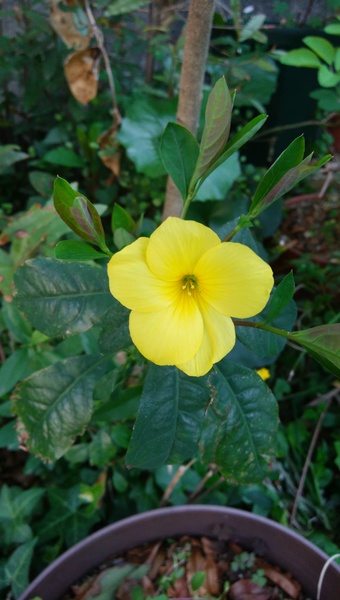
Japanese name: オオキバナカタバミ(大黄花片喰) Scientific name:Oxalis pes-caprae
[Overview]
A perennial 20 cm tall, found in vacant lots and along roadsides.
It has a bulb underground.
The leaves grow in tufts from the bulb and consist of 3 leaflets.
The leaflets are obcordate, heart-shaped with a notched tip, and have purplish brown spots on the surface.
The leaf stalks are long.
An umbel about 20 cm tall, rising above the leaves, bears about 10 flowers.
The flowers are yellow, 5-petaled, and 1.5–4 cm across.
It hardly ever sets fruit.
[History]
Introduced as an ornamental in the middle of the Meiji period, it was confirmed to have naturalized in Kagoshima in 1961, and has become wild in various places.
[Uses]
In South Africa it is used as a vegetable.
[Cultivation]
Propagate by dividing the bulbs.
In a sunny, well-drained place it is easy to grow and multiplies readily.
For potted plants, water thoroughly when the soil surface dries; for plants in the ground, rainfall is sufficient.
It is tolerant of dryness.
Fertilizer is not particularly necessary.
There are no particular pests or diseases.