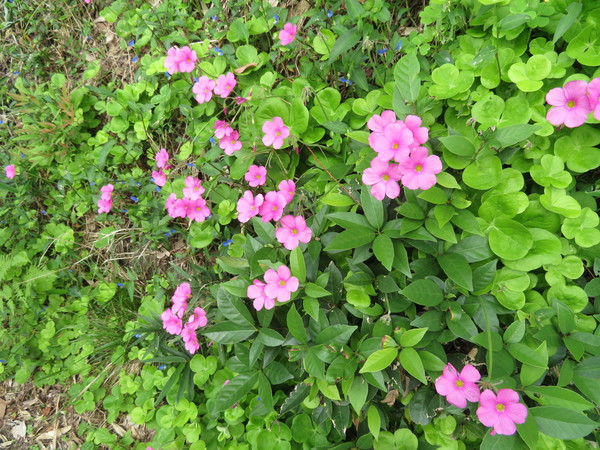
Japanese name: ハナカタバミ(花片喰) Scientific name:Oxalis bowieana
[Overview]
A perennial 30–40 cm tall, found in vacant lots and by roadsides.
There is a bulb and thick, long roots underground.
The leaves grow in tufts from the bulb and consist of 3 leaflets.
The leaflets are obcordate, 4–5 cm long and wide, with a notched tip, making them heart-shaped.
The leaves have petioles 30 cm long.
An umbel about 40 cm tall rises above the leaves and bears 8–12 flowers.
The flowers are 3–5 cm across, deep reddish purple, 5-petaled, with a yellow center.
[History]
It was introduced as an ornamental during the Bunkyu era (1861–1864) at the end of the Edo period, and has become naturalized in many places.
[Cultivation]
Propagate by dividing the bulbs.
It is easy to grow and multiplies well in a sunny, well-drained place.
For potted plants, water thoroughly when the soil surface dries; for plants in the ground, rainfall is sufficient.
It is tolerant of dryness.
Fertilizer is not particularly necessary.
There are no particular pests or diseases.