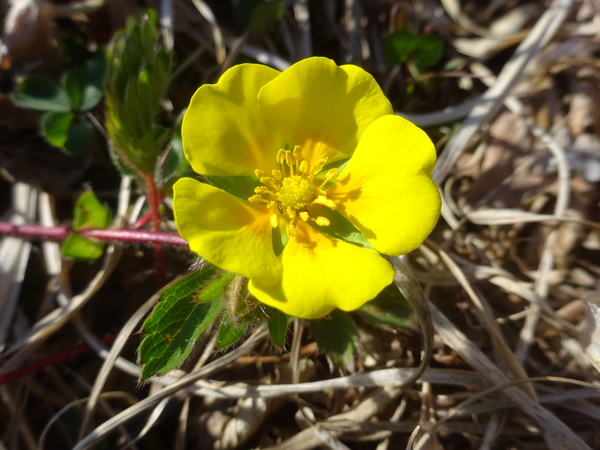
Japanese name: エチゴキジムシロ(越後雉筵、越後雉蓆) Scientific name:Potentilla togasii
[Overview]
A perennial 10–20 cm tall, found at the edges of deciduous forests and on cliffs in the mountains.
It has a thick rhizome that becomes somewhat woody.
It does not produce stolons.
It has basal leaves and leaves arranged alternately on the stem; the basal leaves are usually odd-pinnately compound, 15–35 cm long, with 5 leaflets.
The terminal leaflet and upper lateral leaflets of the basal leaves are rhombic-oblong to obovate, 4–12 cm long and 2–7 cm wide, toothed, and hairy on both surfaces.
The lower lateral leaflets are markedly small and sometimes disappear completely.
The petiole is 5–25 cm long, with soft hairs, and has stipules.
The stem leaves are small trifoliate leaves.
Cymes borne on flower stalks arising from the axils of the basal leaves bear flowers 1.5–2 cm across.
The flowers are yellow with 5 petals, and have a calyx and an epicalyx.
The fruit is an achene.
[Cultivation]
Propagate from seed or by division.
It prefers sunny, well-drained soil.
For potted plants, water thoroughly when the soil surface dries; for plants in the ground, rainfall is sufficient.
In spring and autumn, apply slow-release chemical fertilizer placed on the soil.
There are no particular pests or diseases.