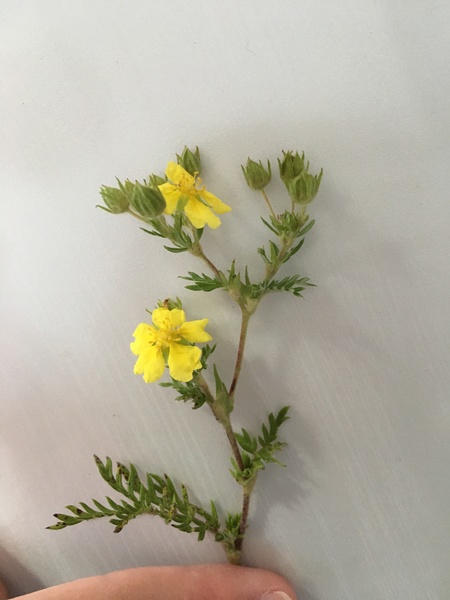
Japanese name: カワラサイコ(河原柴胡) Scientific name:Potentilla chinensis
[Overview]
A perennial 30–70 cm tall, found mainly on dry, sunny, sandy and gravelly riverbeds.
The root is a thick, cylindrical taproot that extends deep into the ground.
The stems branch well at the base and spread, then rise in the upper part and bear long hairs.
The stems and leaf rachises are often tinged with red.
There are basal leaves and leaves alternate on the stem; they are odd-pinnately compound with 15–29 leaflets.
The leaflets are oblanceolate to oblong, pinnately lobed, densely covered with white cottony hairs on the underside, and when dry the margins often roll toward the underside.
Small accessory leaflets are present between the leaflets.
The leaf rachis bears long hairs, and stipules are attached at the base of the petiole.
The stipules of the stem leaves have serrations or deep tooth-like lobes.
Cymes at the stem tips bear many yellow 5-petaled flowers 0.8–1.5 cm across, with notched petal tips.
There is a calyx and an epicalyx; the epicalyx is smaller than the calyx, and both are densely covered with long hairs on the outside.
The fruit is an achene.
[Uses]
The whole plant and the roots are used medicinally.