
Plant Encyclopedia

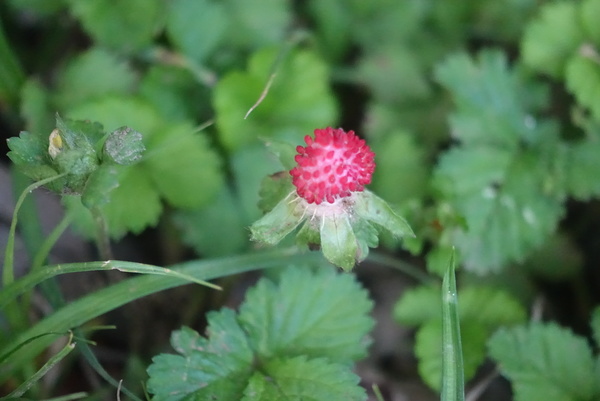
Potentilla hebiichigo
Japanese name: ヘビイチゴ (蛇苺)
Scientific name: Potentilla hebiichigo
[Overview]
A perennial found in sunny grasslands and along roadsides.
The stems creep along the ground and produce roots at the nodes.
It spreads by producing small plantlets, often in autumn, from the rooted parts.
The leaves are alternate and trifoliate, but rarely they are pedate compound leaves made up of 5 leaflets.
The leaves are yellowish green with sparse hairs on both surfaces, and the margins have serrations, often doubly serrate in the upper part.
The terminal leaflet is broadly ovate, 2–2.5 cm long and 1.5–2 cm wide.
The petiole has short hairs.
The flowers are solitary, borne opposite the leaves; they are yellow, 5-petaled, 1.2–1.5 cm across, and the petal tips are distinctly notched.
The flowers have a calyx and an epicalyx.
The flower stalk is 4–7 cm long and hairy.
The flowers open in the morning and close at night.
The receptacle of the fruit is pale pink and dull, spherical, 1–1.2 cm across, soft and spongy, with hairs on the surface.
Achenes about 1 mm long are attached to the surface of the receptacle.
The achenes are dull and wrinkled on the surface.
[Uses]
The whole plant is used medicinally.
Details
Translated from our Japanese encyclopedia. If anything differs, the Japanese page is correct.