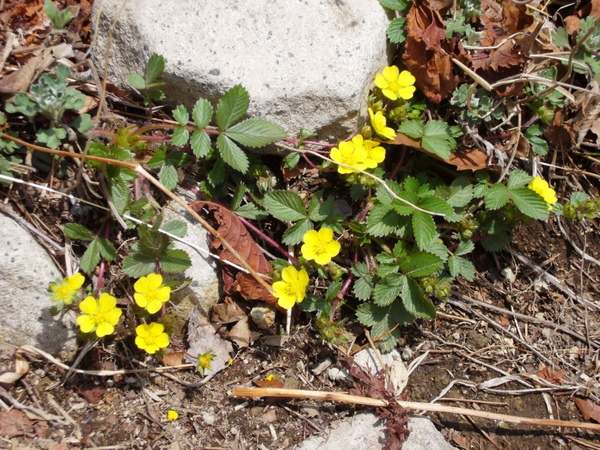
Japanese name: キジムシロ(雉筵、雉蓆) Scientific name:Potentilla fragarioides var. major
[Overview]
A perennial 5–30 cm tall, found in sunny grasslands and by roadsides.
It has a short rhizome.
It does not produce runners.
It is covered with many hairs.
There are basal leaves and leaves alternate on the stem; the basal leaves are usually odd-pinnately compound with 7–11 leaflets, 3–10 cm long at flowering and up to 25 cm long after flowering.
The terminal leaflet and the upper lateral leaflets of the basal leaves are about the same size, broadly ovate to elliptic with serrations, and densely hairy on the veins of the underside.
The lower lateral leaflets gradually become smaller.
The petiole bears spreading hairs and has stipules.
The stem leaves are small and ternately compound.
A cyme is borne on the flower stalk arising from the axil of the basal leaves, bearing flowers 1–1.5 cm across.
The flowers are yellow with 5 petals, and have a calyx and an epicalyx.
The fruit is an achene.
[Cultivation]
Propagate from seed or by division.
It prefers sunny, well-drained soil.
For potted plants, water thoroughly when the soil surface dries; for plants in the ground, rainfall is sufficient.
Apply slow-release fertilizer placed on the soil in spring and autumn.
There are no particular pests or diseases.
[Notes]
The name is said to compare the leaves that emerge after flowering and spread radially to a mat on which pheasants rest.