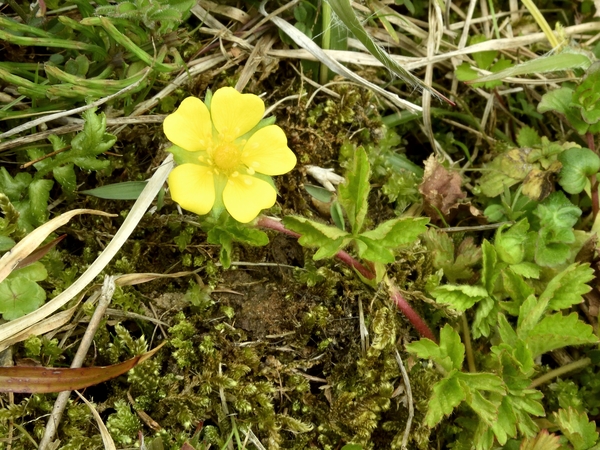
Japanese name: オヘビイチゴ(雄蛇苺) Scientific name:Potentilla anemonifolia
[Overview]
A perennial found on paddy banks, grasslands and similar places.
The stems branch and either rise obliquely or creep along the ground, often rooting at the nodes.
The stems have ascending hairs or are nearly hairless.
The leaves are of two kinds, basal leaves and leaves alternate on the stem; the basal leaves are 3–20 cm long, palmately compound with 5–7 leaflets, and have long petioles.
The leaflets of the basal leaves are elliptic, 2–6 cm long and 1–2.5 cm wide, with coarse serrations along the margin and hairs on the veins of the underside.
The leaves on the stem are ternate compound, rarely simple, with short petioles.
Cymes bear rather many yellow flowers with 5 petals, 0.8–1.2 cm across.
The flowers have a calyx and an epicalyx.
The flower stalk is 5–20 cm long and hairy.
The fruit receptacle is hemispherical, does not become spongy, and has short hairs at the base.
Achenes are borne on the surface of the receptacle.
The achenes are brown with longitudinal wrinkles on the surface.