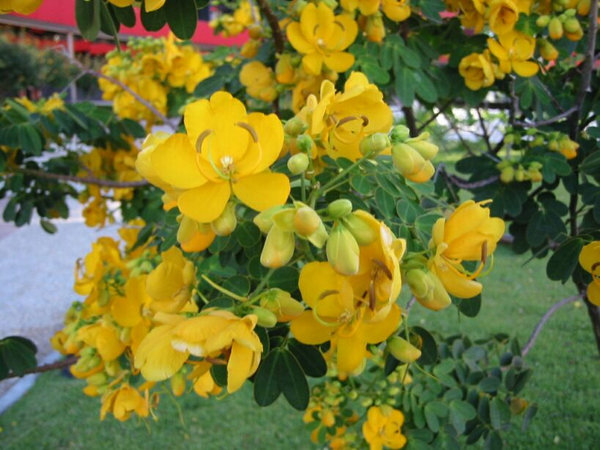
Japanese name: コバノセンナ(小葉栴那) Scientific name:Senna pendula
[Overview]
An evergreen shrub 1–2 m tall, but in cold regions it loses its leaves or dies back in winter.
If left alone, the stems grow in a vine-like manner.
The leaves are alternate and even-pinnately compound, 4–8 cm long, consisting of 3–6 pairs of leaflets.
The leaflets are obovate to broadly ovate, with leaf margins tinged with orange.
Racemes arise from the leaf axils and bear 5–15 flowers.
The flowers are bright yellow and five-petaled; the petals are round and 1.5–2 cm long, and there are 10 stamens.
The fruit is a cylindrical legume 13–18 cm long, but fruiting is rare.
The fruit contains 35–55 seeds.
[Cultivation]
Propagate by cuttings or layering.
It can overwinter if not exposed to frost, and in warm regions it can overwinter outdoors without losing its leaves.
In cold regions, bring it indoors to a sunny spot.
It is easy to grow in any soil as long as the site is sunny and well drained.
It dislikes being transplanted when mature.
Water thoroughly when the soil surface dries.
Fertilizer is unnecessary because it fixes nitrogen from the air by itself.
It is best to cut it back hard after flowering and reshape it.
There are no particular pests or diseases.