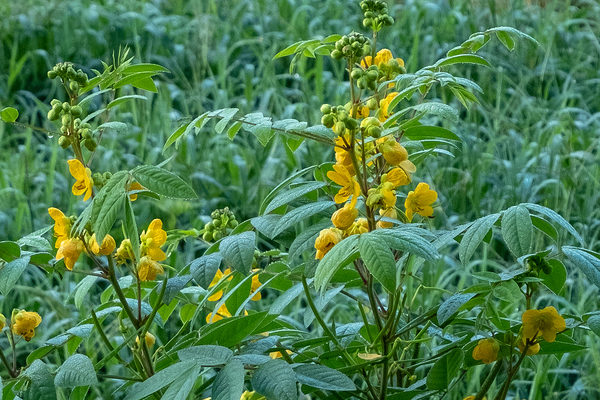
Japanese name: ハブソウ(波布草) Scientific name:Senna occidentalis
[Overview]
An annual 0.8–1.5 m tall, seen along roadsides and in vacant lots.
It is almost hairless throughout.
The leaves are alternate and even-pinnately compound, consisting of 3–6 pairs of leaflets.
The leaflets are ovate to ovate-oblong, 4–10 cm long and 2–3.5 cm wide, with pointed tips.
There is a single nectary only at the base of the petiole, and none on the leaf rachis.
Racemes bear several yellow five-petaled flowers 2 cm across.
There are 10 stamens, of which 3 are staminodes.
The stalk of the inflorescence is 1 cm long or less.
The fruit is a flat, linear legume 7–13 cm long and 0.7–1 cm wide, slightly curved upward, containing 23–30 seeds.
[History]
It was introduced from China as a medicinal plant in the Edo period.
[Uses]
The seeds are called bokonan and are used medicinally; they were also formerly a raw material for habu-cha.
Almost all of what is now used as habu-cha is Ebisu-gusa.
[Cultivation]
Propagate from seed.
It is easy to grow in any soil as long as the site is sunny and well drained.
There are no particular pests or diseases.
[Notes]
The Japanese name comes from the belief that it was effective for wounds from habu bites, but it is said to have no effect on bites.