
Plant Encyclopedia

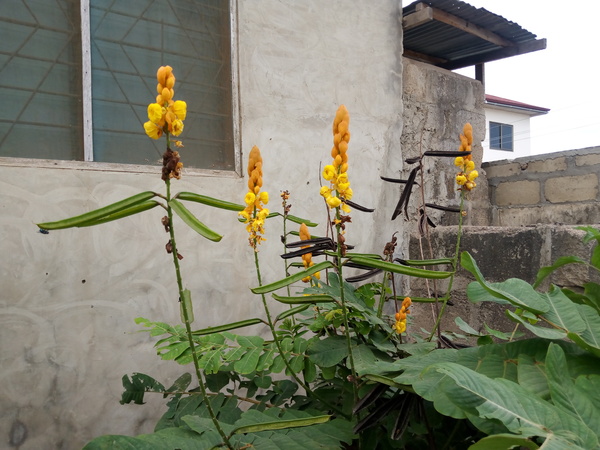
Senna alata (emperor's candlesticks, "Hanesenna")
Japanese name: ハネセンナ (羽栴那)
Scientific name: Senna alata
[Overview]
An evergreen shrub 1–4 m tall, though in cold regions it loses its leaves or dies back in winter.
In its native habitat it prefers wetlands.
The leaves are alternate, even-pinnately compound, 20–75 cm long, made up of 7–14 pairs of leaflets, with the pair at the tip being the largest.
The leaflets are oblong to oblong-obovate, 5–20 cm long, with distinct veins and rounded tips.
The leaves close at night.
Racemes 15–70 cm long arise from the leaf axils or stem tips and bear many densely packed flowers.
The flowers are bright yellow with 5 petals; the petals are rounded and 1.5–2 cm long, and there are 10 stamens.
The inflorescence looks like a yellow candle.
The fruit is a legume 10–20 cm long with 4 well-developed wings, containing 50–70 seeds.
[Uses]
It is used as a vermifuge, a laxative, and for skin diseases.
It is also made into a health tea, but caution is needed because it contains a laxative component (sennoside).
[Cultivation]
Propagate from seed.
It can overwinter if not exposed to frost, and in warm regions it can overwinter outdoors without losing its leaves, even in winter.
In cold regions, bring it indoors to a sunny spot.
It is easy to grow in any soil as long as the site is sunny and well drained.
It has a taproot and dislikes being transplanted.
For potted plants, water thoroughly when the soil surface dries; for plants in the ground, rainfall is sufficient.
Fertilizer is unnecessary because it fixes atmospheric nitrogen by itself.
There are no particular pests or diseases.
Details
Japanese: ハネセンナ(羽栴那)、ハネミセンナ(羽実栴那)、ゴールデンキャンドル、キャンドルブッシュ
Translated from our Japanese encyclopedia. If anything differs, the Japanese page is correct.