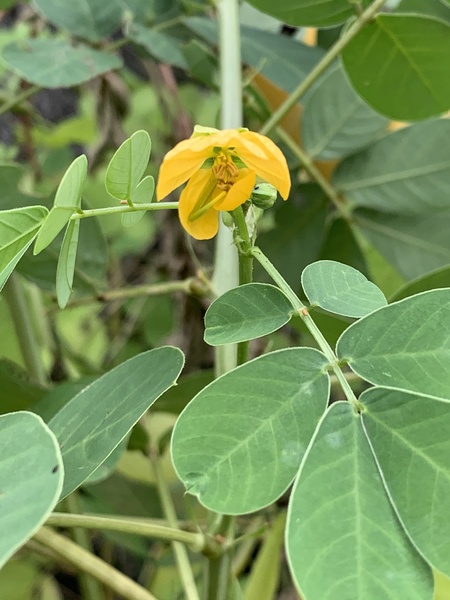
Japanese name: エビスグサ(夷草) Scientific name:Senna obtusifolia
[Overview]
An annual 0.5–2 m tall, found in vacant lots and similar places.
The leaves are alternate and even-pinnately compound, usually composed of 3 pairs of leaflets.
The leaflets are obovate to oblong, 2–6 cm long and 1–2.5 cm wide.
The nectary on the leaf rachis is single, located between the pair of leaflets at the base.
The leaf axils bear 1–2 flowers.
The flowers are yellow and 5-petaled, 1.5–2.5 cm across.
The flower stalk is 1.5–3.5 cm long at flowering and 1.5–4 cm long when in fruit.
The fruit is a cylindrical legume 10–15 cm long, with 25–30 seeds.
[History]
It was introduced from China as a medicinal plant during the Kyoho era of the Edo period.
[Uses]
The seeds are called ketsumeishi; besides being used medicinally, they are the raw material for habu-cha (tea).
[Cultivation]
Propagate from seed.
As long as the site is sunny and well drained, it is not particular about soil and is easy to grow.
There are no particular pests or diseases.