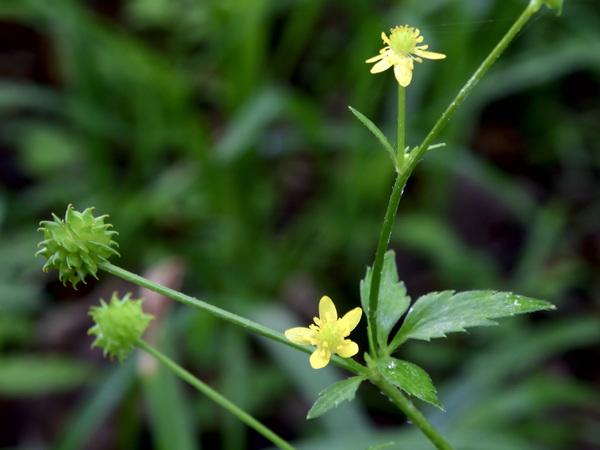
Japanese name: キツネノボタン(狐牡丹) Scientific name:Ranunculus silerifolius
[Overview]
A perennial 20–70 cm tall, found in sunny places such as paddy fields and roadsides, and at woodland edges.
It is often seen in paddy fields in spring before they are plowed.
The stem branches frequently in the upper part.
There are basal leaves and leaves arranged alternately on the stem; 1–3 basal leaves appear, each a ternate compound leaf 2–14 cm long and 2.5–16 cm wide, with shallowly cut lobes that have serrated margins.
Both surfaces of the leaves are sparsely covered with appressed hairs.
The basal leaves have petioles 3–25 cm long.
The stem leaves are divided into 3 lobes all the way to the base, and the petioles are short or absent.
The flowers are borne 2–5 in a cyme at the top of the stem or singly, on flower stalks 1.5–2 cm long.
The flowers are yellow with 5 petals, and the petals are 0.4–0.6 cm long.
The sepals have appressed hairs on the outside and curve back at flowering time.
The fruit is a spherical aggregate fruit 0.8 cm in diameter.
The achenes are 0.3 cm long and flattened, with no border or a border only at the base, and the tip is strongly hooked.
[Uses]
It is poisonous and was used as an insecticide in the past.