
Plant Encyclopedia

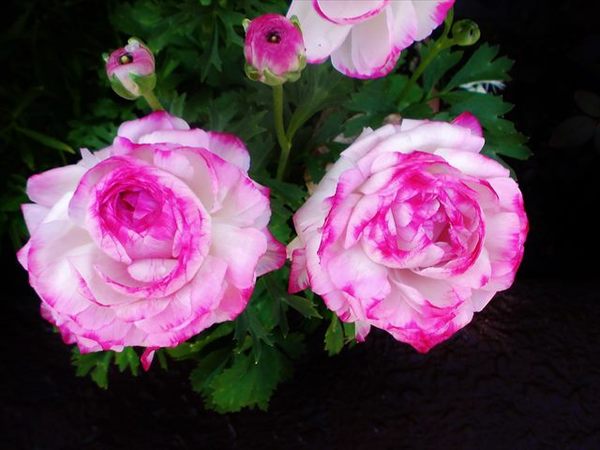
Ranunculus asiaticus (Persian buttercup, "Hanakinpoge")
Japanese name: ハナキンポウゲ (花金鳳花)
Scientific name: Ranunculus asiaticus
[Overview]
A perennial.
It has small tuberous roots underground.
The leaves are of two kinds, basal and stem leaves; the basal leaves are 2–3 times ternately compound, with segments that are toothed or deeply 3-lobed.
There are long leaf stalks, and the base of the leaf stalk forms a sheath.
One to several flower stalks are produced, each bearing several flowers.
The flowers are 5-petaled, 3–5 cm across, and come in a rich variety of colors such as red, pink, orange, purple, yellow and white.
The anthers of the stamens are purplish black.
There are many cultivars, and those generally grown have large double flowers 10 cm or more across.
It grows from autumn to spring, and the aboveground parts die back and go dormant before summer.
[Cultivation]
Propagate from seed or by division of bulbs.
When digging up the bulbs, wait until all the leaves have died back, then dig them up, dry them in the shade, and store them dry in a cool, shaded place.
Bulbs rot easily if planted and watered right away, so before planting, place them on moist sand to absorb water gradually, and plant them after confirming that new roots have begun to grow.
In warm regions it can overwinter outdoors, but in cold regions protect it from frost.
It prefers soil that is sunny, well drained, moisture-retentive, airy and rich in organic matter.
It dislikes acidic soil.
For potted plants, from autumn to spring water thoroughly when the soil surface dries; when the leaves begin to turn yellow, gradually keep it on the dry side, and stop watering during dormancy.
For plants in the ground, rainfall is sufficient.
Apply organic fertilizer as base fertilizer, and give liquid fertilizer during the flowering period.
Stop fertilizing during dormancy.
Pests and diseases include gray mold and aphids.
Details
Japanese: ハナキンポウゲ(花金鳳花)、ラナンキュラス、ハナキツネノボタン(花狐の牡丹)
Translated from our Japanese encyclopedia. If anything differs, the Japanese page is correct.