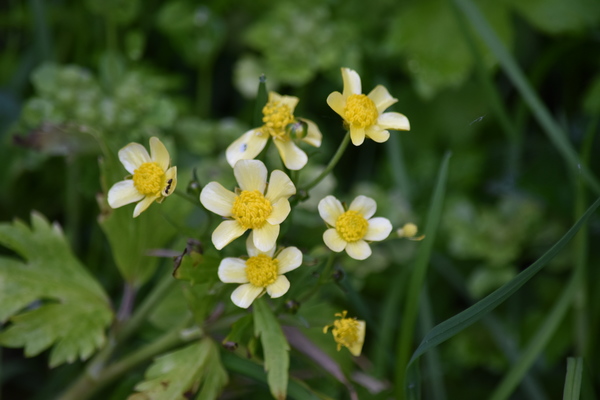
Ranunculus japonicus var. japonicus("Umanoashigata")
Japanese name: ウマノアシガタ(馬足形) Scientific name:Ranunculus japonicus var. japonicus
[Overview]
A perennial 30–120 cm tall, found in sunny grasslands.
The stem branches well in the upper part.
The leaves are of two kinds, basal leaves and leaves on the stem; the basal leaves are 2–12 cm long and 2–14 cm wide, palmately divided into 3 lobes, with appressed hairs on both surfaces.
The petioles of the basal leaves are 3–20 cm long and hairy.
The leaves on the stem are alternate.
Several flowers are borne in a cyme at the stem tip, or a single flower is borne alone; the flowers are yellow with 5 petals, 1.5–2 cm in diameter.
The petals have a metallic sheen.
The fruit is an achene, and many of them gather into a sphere.