
Plant Encyclopedia

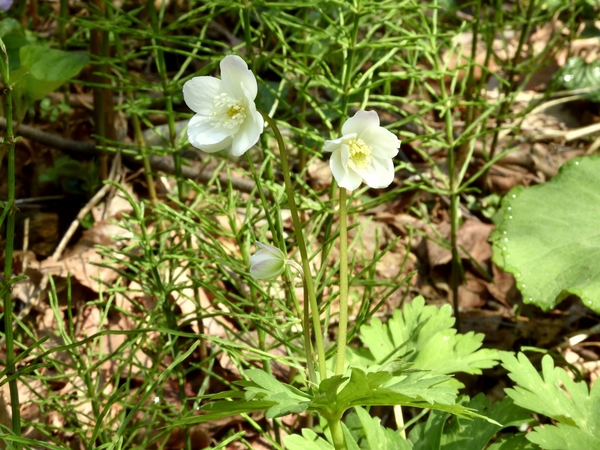
Anemone flaccida var. flaccida ("Nirinso")
Japanese name: ニリンソウ (二輪草)
Scientific name: Anemone flaccida var. flaccida
[Overview]
A perennial growing at the edges and on the floors of deciduous broadleaf forests, often in colonies.
Only one cotyledon emerges.
The rhizome extends sideways and produces basal leaves.
The basal leaves are divided into 3 to the base, the leaflets are cut further, and the upper surface has white spots.
The aboveground part dies back in early summer, making it one of the so-called spring plants (spring ephemerals).
The flower stem grows 10–55 cm tall, and the leaves on the stem are in whorls.
The stem leaves are 3-lobed, have white spots on the upper surface, and have no petioles.
The flowers usually appear in pairs, are about 1–3 cm across and open upward, with 5 elliptic sepals that look like petals.
The sepals are white, sometimes tinged with pale reddish purple on the outside, or green on both sides.
There are many stamens, and the anthers are yellow.
There are also many pistils.
The fruit is an elliptic achene with hairs.
[Uses]
The rhizome is used medicinally, and the young leaves are used as a wild vegetable, but because they resemble the young leaves of torikabuto (monkshood), poisoning accidents have occurred from collecting them by mistake.
[Cultivation]
Propagate from seed or by division.
When growing from seed, sow it fresh, right after it is harvested.
It prefers well-drained, slightly moist, fertile soil in sun to partial shade.
With poor sunlight, flowering is poor.
It is weak to heat and dryness, so keep direct sunlight from reaching the base of the plant.
For potted plants, move them to a cool, shaded place from early summer when the leaves die back, and otherwise keep them in the sun.
It is very cold-hardy, but care is needed against freezing.
For plants in the garden, under deciduous trees is suitable.
For plants in the garden, watering is unnecessary unless it becomes extremely dry.
For potted plants, during the growing season water when the soil surface dries so that the plant does not run short of water.
After dormancy begins, give just enough so that it does not dry out too much.
For fertilizer, place fertilizer on the soil once a month, or apply liquid fertilizer once a week, in spring and autumn.
Pests and diseases include southern blight, anthracnose, gray mold, aphids and slugs.
[Notes]
The Japanese name comes from the flowers blooming two at a time.
Details
Translated from our Japanese encyclopedia. If anything differs, the Japanese page is correct.