
Plant Encyclopedia

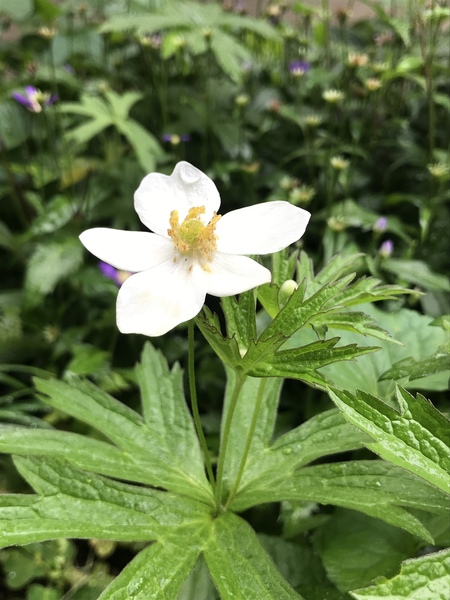
Anemone canadensis (Canada anemone)
Japanese name: カナダイチゲ
Scientific name: Anemone canadensis
[Overview]
A perennial that spreads in colonies by extending slender rhizomes.
The basal leaves are palmately cut to the base, the lobes are cut further, and the petioles are long.
The flower stem grows 30–50 cm tall, and the leaves on the stem are opposite.
The stem leaves are 3-lobed, the lobes are cut further, and there are no petioles.
The veins are sunken on the upper surface of the leaves.
The flowers are about 3–5 cm across, with 5 elliptic sepals that look like petals, and open upward at the tips of flower stalks that extend above the leaves.
There are 80–100 stamens, and the anthers are yellow.
There are also many pistils.
The fruit is an achene with a long beak at the tip.
[Cultivation]
Propagate from seed or by division.
It prefers a well-drained place in sun to partial shade, and under deciduous trees is suitable for garden planting.
It is very cold-hardy, and once established in the garden it requires little care.
For potted plants, water when the soil surface dries; for plants in the garden, watering is unnecessary unless it becomes extremely dry.
Fertilizing can be light; for potted plants, watching the plant's condition, place fertilizer on the soil once a month, or apply liquid fertilizer once a week, in spring and autumn.
There are no particular pests or diseases.
Details
Japanese: カナダイチゲ、アネモネ カナデンシス、メドウアネモネ、春咲きシュウメイギク、フタマタイチゲ
Translated from our Japanese encyclopedia. If anything differs, the Japanese page is correct.