
Plant Encyclopedia

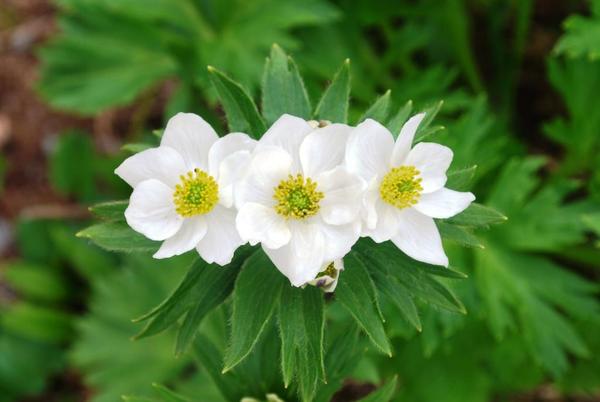
Anemone narcissiflora subsp. nipponica ("Hakusan'ichige")
Japanese name: ハクサンイチゲ (白山一華)
Scientific name: Anemone narcissiflora subsp. nipponica
[Overview]
A perennial forming large colonies in flower meadows from the subalpine to the alpine zone.
The rhizome extends vertically.
The whole plant is densely hairy.
Two to six basal leaves and 1–7 flower stalks arise from the rhizome.
The basal leaves are divided or deeply cut into 3, and the leaflets or segments are obovate, 2–6 cm long and 1.5–5 cm wide.
The basal leaves have petioles.
The flower stalk grows 10–40 cm tall, and the leaves on the stem are whorled, 4 at a time, and stalkless.
The stem tip bears a solitary flower, or 2–6 flowers in an umbel.
The flowers are about 1.5–3 cm across and open upward, with 5–7 elliptic white sepals that look like petals.
There are many stamens, with yellow anthers.
There are also many pistils.
The flower stalk has no bracteoles; it is 1–4 cm long and grows to 15 cm when in fruit.
The fruit is a flattened, winged achene that ripens black, with a hooked style remaining at the tip.
[Cultivation]
Propagate by division.
It dislikes heat and dryness, so it suits cold regions.
In cold regions it can be kept in the sun all year, but elsewhere keep it in summer in a cool, airy place in partial shade.
It prefers well-drained soil, so plant it in mountain sand mixed with sphagnum moss, or in kanuma soil or pumice.
Soil for mountain and wild plants may also be used.
During the growing season, water when the soil surface dries so that the soil never dries out.
After dormancy, water only enough to keep the soil from drying out too much.
In spring, apply slow-release fertilizer placed on the soil, and make sure no fertilizer remains in summer.
Pests and diseases include southern blight, anthracnose, gray mold, aphids and slugs.
Details
Translated from our Japanese encyclopedia. If anything differs, the Japanese page is correct.