
Plant Encyclopedia

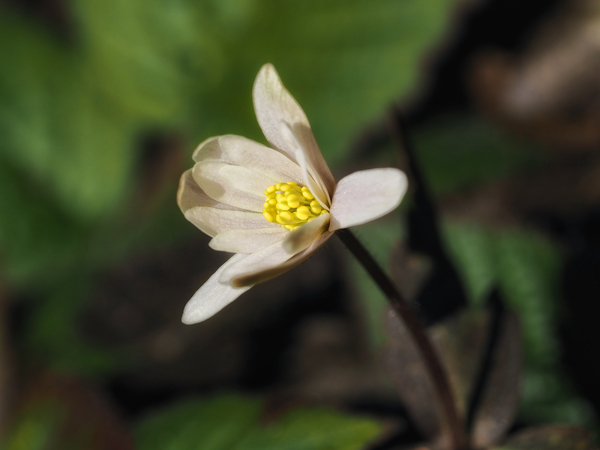
Anemone keiskeana ("Yukiwariichige")
Japanese name: ユキワリイチゲ (雪割一華)
Scientific name: Anemone keiskeana
[Overview]
A perennial growing at the edges and on the floor of coppices and bamboo groves, often forming colonies.
The rhizome is often tinged with purple and creeps and spreads sideways.
One to three basal leaves and one flower stalk arise from the rhizome.
The basal leaves are divided into 3 to the base.
The upper surface of the leaflets is green with white blotches, and the underside is red-purple.
The leaflets have serrated margins and no leaflet stalks.
The basal leaves appear in autumn, and the aboveground part dies back in early summer of the following year, making it one of the so-called spring ephemerals.
The flower stalk grows 15–30 cm tall, and the leaves on the stem are whorled, 3 at a time.
The stem leaves are stalkless and deeply notched.
A solitary flower is borne at the tip of the stem.
The flower is 3–3.5 cm across, with 12–22 oblong pale purple sepals that look like petals.
There are many stamens, with yellow anthers.
There are 10–14 pistils.
The fruit is an elliptic achene about 6 mm long, but fruit is not normally produced.
[Cultivation]
Propagate usually by division.
It prefers sun to partial shade and fertile, well-drained, slightly moist soil.
In poor sunlight, flowering is poor.
It dislikes heat and dryness, so keep direct sunlight off the base of the plant.
For potted plants, move them to a cool, shaded place from about the time the leaves die back in early summer, and otherwise keep them in the sun.
It is very cold-hardy, but care is needed against freezing.
For planting in the garden, the area under deciduous trees is suitable.
For plants in the garden, watering is unnecessary unless the soil becomes extremely dry.
For potted plants, during the growing season water when the soil surface dries so that the soil never dries out.
After dormancy, water only enough to keep the soil from drying out too much.
Fertilize in spring and autumn with fertilizer placed on the soil once a month or liquid fertilizer once a week.
Pests and diseases include southern blight, anthracnose, gray mold, aphids and slugs.
Details
Translated from our Japanese encyclopedia. If anything differs, the Japanese page is correct.