
Plant Encyclopedia

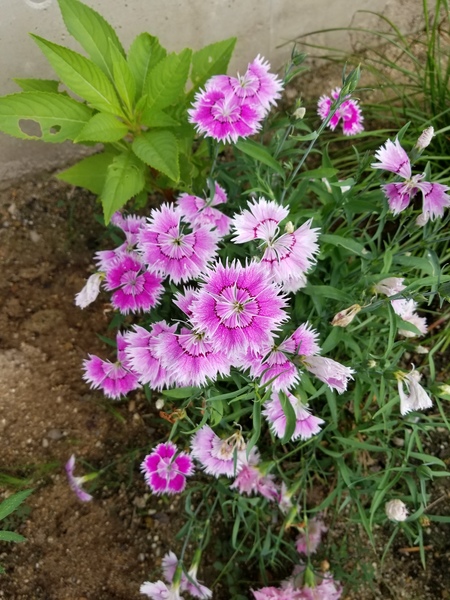
Dianthus chinensis (rainbow pink, "Sekichiku")
Japanese name: セキチク (石竹)
Scientific name: Dianthus chinensis
[Overview]
A perennial 30–50 cm tall, treated as an autumn-sown annual.
The whole plant is tinged with gray.
The stems grow in clumps, are erect, and branch in the upper part.
The stems have blunt ridges and short hairs, and the nodes are swollen.
There are basal leaves and stem leaves; the stem leaves are simple and opposite, linear-lanceolate to broadly lanceolate, 3–5 cm long and 0.2–0.4 cm wide, with the base clasping the stem.
The flowers are borne singly at the stem tips or in cymes.
There are 4–6 pointed bracts at the base of the inflorescence.
The flowers have 5 petals and are about 3–5 cm across, with finely cut petal tips.
The fruit is a cylindrical capsule that splits into 4 at the tip when ripe, releasing black seeds.
[Uses]
The seeds are called kumugishi and are used medicinally.
[Cultivation]
Propagate from seed, by division, or by stem cuttings.
It prefers sunny, well-drained soil.
Soil acidity should be neutral to slightly alkaline.
For potted plants, water thoroughly when the soil surface dries; for plants in the ground, rainfall is sufficient.
Once a base fertilizer has been applied, no further fertilizer is particularly necessary.
There are no particular pests or diseases.
Details
Japanese: セキチク(石竹)、カラナデシコ(唐撫子)、コウアンナデシコ(興安撫子)、モウコナデシコ(蒙古撫子)
Translated from our Japanese encyclopedia. If anything differs, the Japanese page is correct.