
Plant Encyclopedia

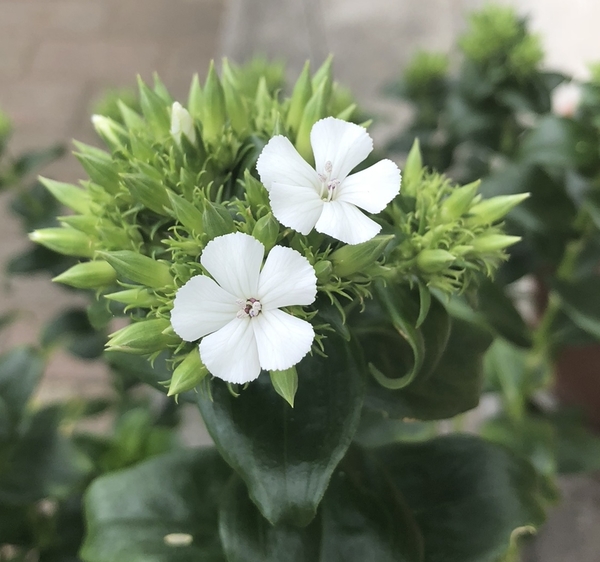
Dianthus japonicus f. albiflorus ("Shirobanahamanadeshiko")
Japanese name: シロバナハマナデシコ (白花浜撫子)
Scientific name: Dianthus japonicus f. albiflorus
[Overview]
A perennial 15–50 cm tall, growing on seashores.
The lower part of the stem becomes woody and is slightly creeping, while the upper part is erect.
There are basal leaves and stem leaves; both are thick, glossy and entire.
The basal leaves are simple, form a rosette, and are oblanceolate-oblong, 5–9 cm long.
The stem leaves are simple and opposite, long ovate to oblong-lanceolate, 4–8 cm long and 1–2.5 cm wide, with rounded tips.
Cymes at the stem tips densely bear many flowers.
The flowers of one inflorescence open almost simultaneously.
The base of the inflorescence has 3 pairs of elliptic bracts, and the bract tips extend in a tail-like manner.
The flowers are white, 5-petaled, about 1.5 cm across.
The petal tips are shallowly cut into teeth, and the claw-like bases are hidden inside the calyx, which is fused into a tube.
The fruit is a cylindrical capsule that splits into 4 at the tip when ripe, releasing black seeds.
[Cultivation]
Propagate from seed.
It prefers sunny, well-drained sandy soil.
Keep the soil pH neutral to slightly alkaline.
It is somewhat sensitive to cold, so avoid cold winter winds.
For potted plants, water thoroughly when the soil surface dries.
For plants in the ground, rainfall is sufficient.
Once base fertilizer has been applied, no further fertilizing is particularly necessary.
There are no particular pests or diseases.
Details
Translated from our Japanese encyclopedia. If anything differs, the Japanese page is correct.