
Plant Encyclopedia

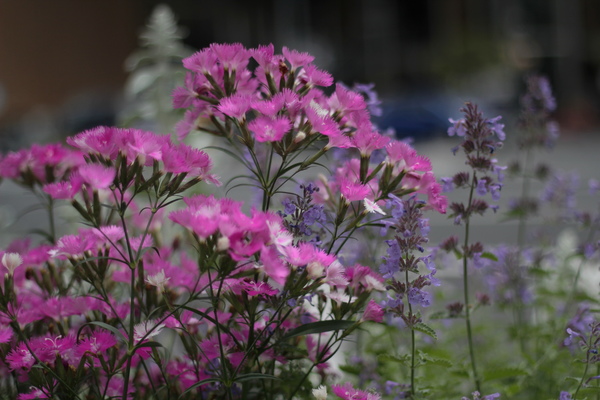
Dianthus superbus var. longicalycinus ("Kawaranadeshiko")
Japanese name: カワラナデシコ (河原撫子)
Scientific name: Dianthus superbus var. longicalycinus
[Overview]
A perennial 30–80 cm tall, found mainly in sunny grasslands and on riverbeds.
The stem is erect, branches in the upper part, and has swollen nodes.
The leaves are simple and opposite, linear to lanceolate, 3–9 cm long, and tinged with a powdery white.
The leaf bases clasp the stem.
Cymes at the stem tips bear flowers sparsely.
The base of the inflorescence has 3–4 pairs of bracts, and the bract tips are pointed.
The flowers are pale pink, 5-petaled, about 4–5 cm across.
The petal tips are deeply split into thread-like segments.
The fruit is a cylindrical capsule that splits into 4 at the tip when ripe, releasing black seeds.
[History]
It is one of the Seven Herbs of Autumn.
It appears in the Man'yoshu, The Tale of Genji and The Pillow Book.
[Uses]
The whole plant and the seeds are used medicinally.
It has been a parent in crosses with Ise-nadeshiko and other Dianthus plants.
[Cultivation]
Propagate from seed, by division, or by cuttings.
It prefers a sunny, airy, well-drained soil.
Keep the soil pH neutral to slightly alkaline.
Keep it on the dry side: for potted plants, water thoroughly when the soil surface dries.
For plants in the ground, rainfall is sufficient.
Excess moisture causes root rot and disease.
Apply slow-release fertilizer placed on the soil once a month in spring and autumn.
There are no particular pests or diseases.
Details
Translated from our Japanese encyclopedia. If anything differs, the Japanese page is correct.