
Plant Encyclopedia

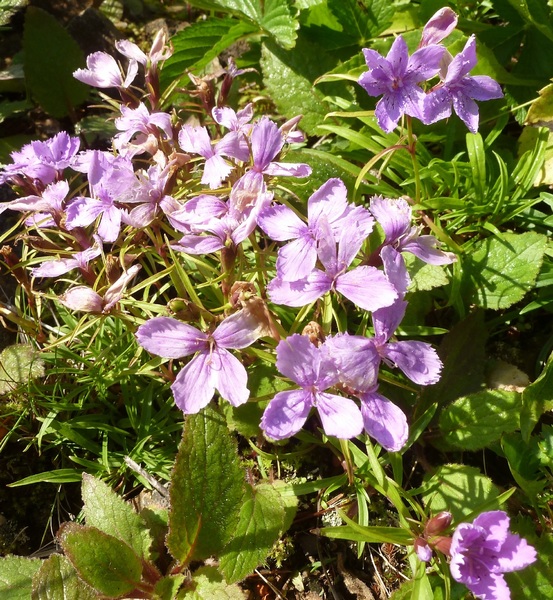
Dianthus shinanensis
Japanese name: シナノナデシコ (信濃撫子)
Scientific name: Dianthus shinanensis
[Overview]
A biennial or perennial 20–40 cm tall, growing on riverbeds in the mountains and on gravelly ground in the subalpine zone.
The stem branches from the base, is erect, and is hairless.
There are basal leaves and stem leaves; neither is glossy.
The basal leaves are simple, form a rosette, and are oblanceolate, 3–6 cm long.
The stem leaves are simple and opposite, linear-lanceolate, 3–7 cm long and hairless; the base clasps the stem and is tinged with red.
Cymes at the stem tips densely bear many flowers.
The flowers of one inflorescence open almost simultaneously.
The base of the inflorescence has 2 pairs of elliptic bracts, and the bract tips extend in an awn-like manner.
The flowers are reddish purple, 5-petaled, about 2 cm across.
The petal tips are shallowly cut into teeth, and the claw-like bases are hidden inside the calyx, which is fused into a tube.
The fruit is a cylindrical capsule that splits into 4 at the tip when ripe, releasing black seeds.
[Cultivation]
Propagate from seed or by cuttings.
It prefers a sunny, airy, well-drained soil.
Keep the soil pH neutral to slightly alkaline.
It dislikes heat and humidity, so keep it on the dry side: for potted plants, water thoroughly when the soil surface dries, and for plants in the ground, rainfall is sufficient.
Excess moisture causes root rot and disease.
In spring and autumn, apply slow-release fertilizer placed on the soil, so that no fertilizer remains in midsummer.
Cutting it back before summer to improve airflow makes it easier to get through the summer.
There are no particular pests or diseases.
Details
Translated from our Japanese encyclopedia. If anything differs, the Japanese page is correct.