
Plant Encyclopedia

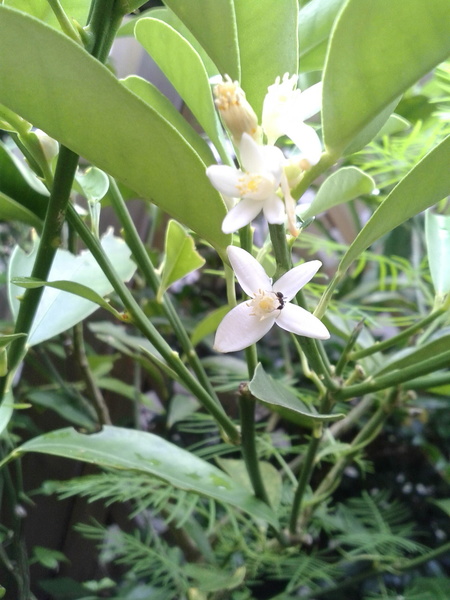
Citrus hanayu
Japanese name: ハナユ (花柚)
Scientific name: Citrus hanayu
[Overview]
An evergreen shrub about 1.5 m tall.
The alternate leaves look simple but are reduced compound leaves; they are entire, leathery, and have narrow wings.
The flowers are white and fragrant.
The many stamens are fused up to the middle of the filaments, forming a staminal tube.
The fruit is an oblate sphere of about 70–80 g with an uneven surface, ripening yellow.
[History]
One theory holds that it was introduced from southern China, while another holds that it originated in Japan.
[Uses]
The fruit peel has a yuzu-like fragrance and is used as a condiment and the like.
The juice is strongly sour and is used as vinegar.
[Cultivation]
Propagate by grafting.
It prefers a site with sun, good drainage and good water retention.
Young trees are easy to transplant, but mature trees are difficult.
For plants in the ground, watering is unnecessary unless sunny weather continues and the soil dries out, but for young trees, watering well in summer to encourage the branches to grow long speeds up growth.
In spring and autumn, apply organic fertilizer or fast-acting chemical fertilizer.
If the branches become too dense and the inside of the crown gets too little sunlight, the branches die.
Dead branches cause pests and diseases and reduce fruiting, so around March thin and prune appropriately so that sunlight reaches the inside.
If many fruits set, thin them in July–August.
Pests and diseases include melanose, canker, citrus leafminer, scale insects, spider mites and aphids.
It is a food plant of swallowtail butterfly larvae.
Details
Translated from our Japanese encyclopedia. If anything differs, the Japanese page is correct.