
Plant Encyclopedia

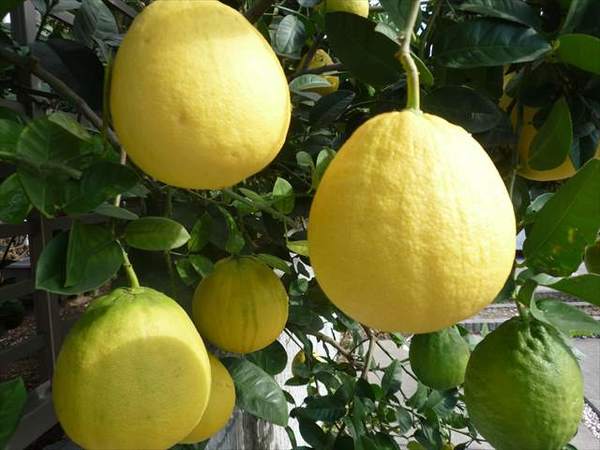
Citrus maxima ("Zabon")
Japanese name: ザボン (朱欒)
Scientific name: Citrus maxima
[Overview]
An evergreen tree cultivated as a fruit tree.
The tree is round in shape, and the branches are long and sparse.
The leaves are alternate, elliptical, with shallow serrations on the margin.
They look simple, but are actually degenerated compound leaves and have winged petioles.
The flowers are borne in racemes; they are white, 4–5-petaled and fragrant.
Many stamens are fused up to the middle of the filaments, forming a staminal tube.
The fruit ripens yellow and is spherical, oblate or obovate depending on the cultivar; at 1–2 kg it is among the largest of the citrus fruits, and the rind is also thick.
[History]
It is thought to have come to Japan in the Azuchi-Momoyama period to the early Edo period.
[Uses]
The fruit is eaten as a fruit, and the rind is also used to make candied fruit.
[Cultivation]
Propagate by grafting.
It is weak in cold tolerance, and areas with an annual mean temperature of 18°C or higher are suitable for cultivation.
Care is also needed in the humidity of summer.
It prefers a sunny, well-drained location with good water retention.
It dislikes cold, so it is best planted on the south side of a building where it is sheltered from the north wind in winter.
Young trees transplant easily, but mature trees are difficult to transplant.
For plants in the ground, watering is unnecessary unless sunny weather continues and the soil dries out.
In spring and autumn, apply organic fertilizer or a fast-acting chemical fertilizer.
If the branches become too dense and the inside of the crown gets too little sunlight, the branches die.
Dead branches cause pests and diseases and reduce fruit set, so around March prune and thin moderately so that sunlight reaches the inside.
If many fruits set, thin them in July–August.
Pests and diseases include melanose, canker, citrus leafminer, scale insects, spider mites and aphids.
It is a food plant of swallowtail butterfly larvae.
Details
Translated from our Japanese encyclopedia. If anything differs, the Japanese page is correct.