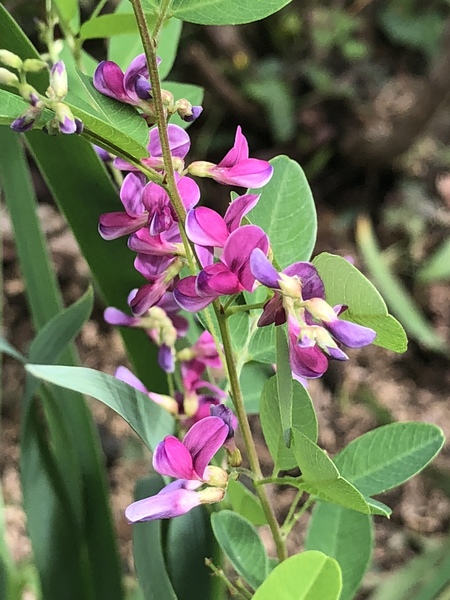
Lespedeza melanantha f. rosea("Benikurobanakihagi")
Japanese name: ベニクロバナキハギ(紅黒花木萩) Scientific name:Lespedeza melanantha f. rosea
[Overview]
A deciduous subshrub 20–50 cm tall.
The leaves are alternate and compound, consisting of 3 leaflets, which are elliptic.
The leaf margins are entire.
The flowers are pea-shaped, borne in inflorescences that emerge from the leaf axils, and are deep reddish purple.
[Cultivation]
It prefers a sunny, well-drained, well-ventilated site and is easy to grow; it will grow even in poor or dry soil as long as the soil is not overly wet.
It is cold-hardy, but most of the above-ground part dies back in winter, so cut it back to ground level and let new branches grow the following year.
Transplanting is easy as long as it is done while the plant has no leaves.
For potted plants, water thoroughly when the soil surface dries; for plants in the ground, rainfall is sufficient unless summer brings a long spell of sunny weather and the soil becomes severely dry.
Fertilizer is not particularly necessary.
Diseases and pests include rust and aphids.